

Can A Candy Shape Be A Trademark? Yes, it can! I’ve spoken before about shapes as trademarks for candy, Toblerone being the most famous one. What about other, less distinctive shapes? Those can serve as trademarks as well. As I like to remind everyone, anything, so long as it distinguishes your goods and services from other people’s goods and services, can serve as a trademark. And the shape of candy is no exception.
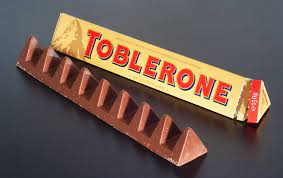
Remember that a trademark must be distinctive. It must serve as a source identifier for the goods; it can’t be merely decorative, such that the public does not perceive it as a trademark. This is because in order to function as a trademark and serve the purpose of a trademark, it must enable consumers to distinguish it from other goods of the same type. When I see a candy bar that is a triangular shape, I know that it’s from Toblerone. The shape is distinctive from that of other candy, such that I can tell it’s made by Toblerone just by the way it looks.
There are only so many shapes for candies, so you can’t register just any shape for a candy. If we allowed one manufacturer, for example, to register as a trademark the shape of an orb, it would prevent other manufacturers from making these shapes, which would limit the customary shape of many candies.
You can see that Toblerone bar in the photo above has this distinctive triangular shape that is actually registered as a trademark, but somebody else asked me some more questions about whether or not a certain candy was registered as a trademark. And while I didn’t find that, I did find a couple more that I wanted to call to your attention. So I was perusing the trademark database as I am wont to do, and I found these. So this is one of the Baci candies from Ferrero Rocher.
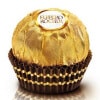
I’m sure you’ll recognize it. Here’s how the manufacturer, when they applied for the trademark, described the trademark: “The mark consists of a candy, a gold wrapped candy ball with brown and gold striped wrapper at the base of the ball. There is a white oval in the middle of the ball. The oval is outlined by a gold, white and red stripe. The color gold is claimed as a feature of the mark. So here we have a gold ball wrapped candy with another wrapper that’s different colors around the base. And that’s what that manufacturer is choosing as a trademark.
Here’s another shape trademark for candy, one that is a little less distinctive, but nonetheless registered as a trademark. Here’s how the applicant described the trademark: “The mark consists of a three-dimensional oval shaped candy with slightly flattened sides and rounded edges. Color is not claimed as a feature of the mark. The shading does not indicate color, but rather emphasizes the three-dimensional quality of the mark.” See Trademark Registration 4051861 for the trademark description.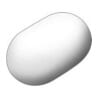 Here we have the shape of a mint being claimed as a trademark. I’m surprised that this shape was considered distinctive enough to register.
Remember, the claiming of a shape as a trademark has to be distinctive. Why? Because that is the entire function of a trademark in the first place. If the trademark doesn’t enable the consuming public to choose the goods and services based on the trademark, then it’s not serving as a trademark. The trademark has to be distinctive enough from other products so that I can say, hey, when I find this on the store shelf, I know it’s Toblerone and not anybody else’s candy — just by the shape — that makes it a trademark, the distinctiveness.
The other reason why it needs to be distinctive is because when you’re granted a trademark, you are in essence granted a monopoly on that trademark. So if we allow people to register as trademarks common candy shapes like the shape of an orb — there are lots of candies that are in the shape of an orb or a lozenge or in a flattened lenticular shape; many mints are shaped that way, like a circular, flattened little orb. So if we allow one company to register that as a trademark, it would necessarily prohibit other manufacturers from making that very common shape. This is why the shape must be distinctive.
Now, let’s look at an example of a brand that was denied trademark protection because it wasn’t distinctive enough to serve as the trademark.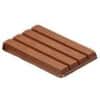 The one I’m talking about is Kit Kat, and here it is, above. They were denied protection under the trademark laws because it’s very common to to use this sort of elongated lozenge-type bar shape with the breakpoints there that you see on the tablet. It is so common that the Trademark Office said, “We can’t let you register that as a trademark, because if we do, it’s going to eliminate the ability for other manufacturers to make something in this very common shape.” There are limits in what you can register as a shape trademark; it has to be distinctive, and not commonly used.
You can find me online at TrademarkDoctor.net. I’m also on YouTube. I have a huge channel there with about 500 videos on it that will probably answer just about all of your trademark questions if you spend enough time there. If you would like to get all of my newest content, like and subscribe and I will see you on the next video.
I’m also on Facebook! “Like” my facebook page, to be notified every time I go LIVE. Do you have trademark questions? Drop a comment on a video on the Trademark Doctor Facebook page, and I’ll answer your questions on a future Live video.
Contact Dallas, Texas trademark attorney Angela Langlotz today to get started on a trademark application for your valuable brand.
Very interesting read! I always thought protecting the shape of a product would be more akin to a copyright since that’s an original expression fixed in a tangible medium — but pursuing a trademark makes a lot of sense. Although it’s interesting that KitKat wasn’t granted a trademark whereas Toblerone was. I guess I have to read the office actions for KitKat if they are available to the public.
Yes, you can read all the file history at USPTO.gov. Just type in the serial number into the search tool.