

In the United States, trademark classes 1-34 cover goods and classes 35-45 cover services, and your application must identify the relevant offerings and classes. Those choices shape the protection you seek, so broad or vague wording can create problems, while descriptions that miss core offerings may leave gaps.
This guide explains how to choose descriptions that fit your business, search the USPTO Trademark ID Manual, and understand how your choices affect your application and trademark protection.
Key Takeaways
- Match your application’s goods and services descriptions to what your business offers and plans to offer soon.
- A trademark professional can help align your offerings with appropriate descriptions and classes.
- The USPTO Trademark ID Manual can help identify descriptions, but the right entry depends on the details of your offering.
- Your selected goods and services shape the scope of the trademark protection you seek.
How can a trademark professional help you choose goods and services for your trademark?
A trademark professional reviews your actual offerings, near-term plans, and how customers encounter your mark, then maps those details to application descriptions. In the United States, goods fall within Classes 1-34 and services within Classes 35-45, so the professional first distinguishes what you sell from what you do for customers.
How Professionals Filter by Class and Classification Version
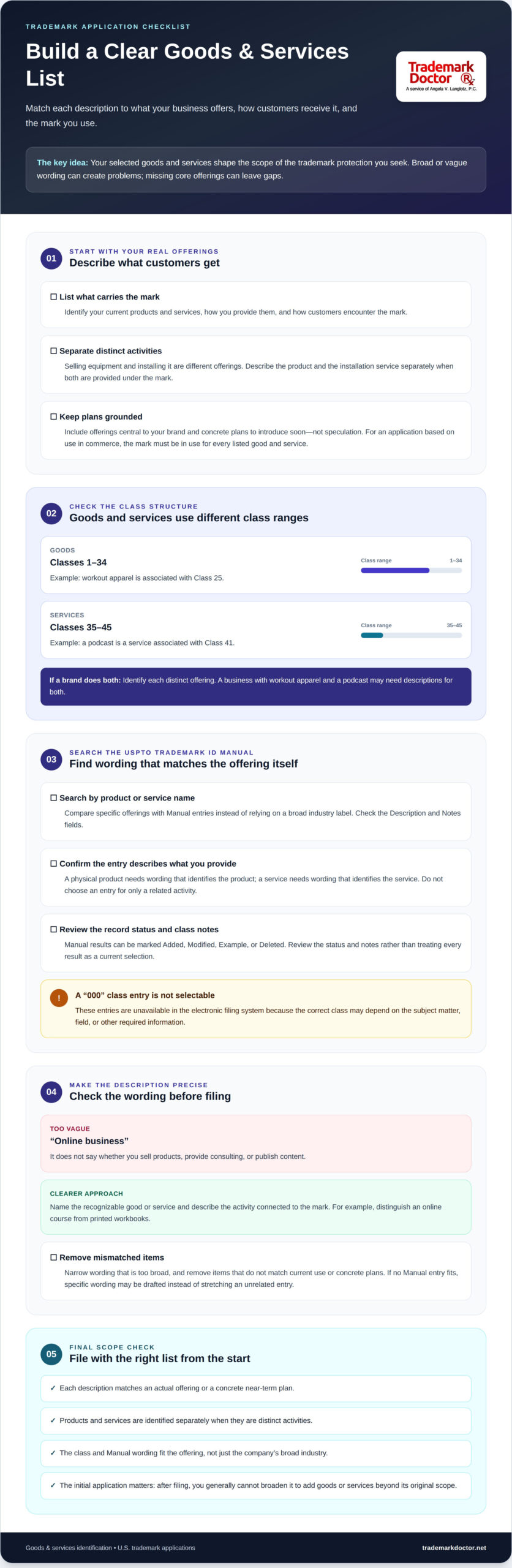
A trademark professional compares each offering with the class structure and the version of the Nice Classification reflected in the USPTO Trademark ID Manual. This review matters because similar business labels can describe different activities. A company that sells equipment and separately installs it, for example, may need to identify both the products and the installation service. Descriptions should reflect the activity connected to the mark, not simply the company’s broad industry.
Examples Across Product and Content Types
Class examples show why a professional separates offerings instead of treating a brand as one undivided business. A fitness brand selling workout apparel is associated with Class 25, while a podcast is an example of a service associated with Class 41. If a business operates both, the application may need descriptions for each distinct offering. The professional assesses how each item is provided to customers before selecting wording.
Avoiding Broad or Incorrect Classifications with Professional Help
A trademark professional checks whether each description clearly identifies a recognizable good or service. A vague phrase such as “online business” does not say whether you sell products, provide consulting, or publish content. The wording can be tailored to the activity itself, while removing items that do not match your current use or concrete plans. This keeps the application focused and avoids relying on an incorrect class label.
After filing, you generally cannot broaden an application to add goods or services beyond its original scope. That makes the initial choices important: descriptions should reflect the brand’s actual offerings before submission. A trademark professional can review the list with you and identify when a separate application may be needed for a later expansion.
Choosing Goods or Services for a Trademark Application with Professional Help
A trademark professional helps identify which offerings belong in a U.S. trademark application by examining what your business provides under the mark. Share details about your current products and services, customer experience, and concrete plans so the application’s identifications can reflect that context.
How Professionals Identify Application Goods and Services
Start with your actual business activity, not just your company name or industry. Describe what customers receive, how you provide it, and which offerings carry the mark. For example, a business may sell a product and separately provide installation or instruction. Those are distinct activities, so the application should describe each clearly. Details about packaging, service delivery, and planned launches can help distinguish what belongs in the filing.
Selecting Items for a U.S. Application with Professional Help
Prioritize offerings that are central to your brand and those you genuinely plan to introduce soon. This keeps the application connected to business activity rather than speculation. Review proposed descriptions for clarity and check that each identifies a recognizable good or service. If wording is too broad, narrow it to specify the product or service customers receive.
The filing basis also affects which items belong in the application. For an application based on use in commerce, the mark must be in use for every listed good and service. Do not describe a planned product that is not yet offered as though it is already in use. Separate active offerings from future plans and consider how that distinction affects the filing.
Before submission, the professional can review the complete list for consistency. For instance, if your business offers an online course and printed workbooks, the descriptions should distinguish the educational service from the physical materials. A focused review helps the application describe the mark’s real commercial role. To discuss application preparation, explore professional trademark application filing support.
How a trademark professional searches the USPTO Trademark ID Manual
Use the USPTO Trademark ID Manual to find descriptions that match your actual goods or services. The Manual is a searchable database of identifications and classifications. Instead of relying on a broad industry label, compare your specific offering with relevant entries. The application should identify recognizable goods or services, not leave an examiner guessing about what your business provides. The trademark goods and services selection process starts with the details of what you offer.
Start a search with the product or service name, then narrow the results using the Manual’s Description and Notes fields. Check whether an entry describes the offering itself, not merely a related activity. For example, a brand selling a physical product needs wording that identifies the product, while a brand providing a service needs wording that identifies the service. Matching an entry to your actual business activity keeps the description clear and makes trademark goods and services selection more precise.
Search results include record-status filters for Added, Modified, Example, and Deleted entries. Review each entry’s status and notes rather than treating every result as a current selection. The Class Number field is read-only; clicking it or pressing Enter or Space opens the class selection panel. These details help confirm an entry’s classification and avoid relying on a deleted or illustrative record.
Some Manual entries show “000” in the Class field. Those entries are unavailable for selection in the electronic filing system because the correct class may depend on the subject matter, field, or other required information. If no listed identification accurately covers your offering, a professional can draft specific wording instead of stretching an unrelated entry. A description should make clear what goods or services you actually provide.
How goods and services define trademark protection
The descriptions and classes in your application help define the goods and services covered by a registration. That scope also matters when assessing potential conflicts with existing marks.
Defining the Scope of Protection
According to the United States Patent and Trademark Office, trademark goods and services are organized into 45 classes: 34 classes for goods and 11 classes for services. A registration applies to the goods and services identified in the application, within the class or classes selected. The practical takeaway is clear: the class number alone does not describe your protection. The listed items matter, too.
Consider a beauty brand that sells skincare products and publishes educational content. These activities may involve different classes because products and content are distinct offerings. If the application identifies only the skincare goods, it may not cover the brand’s content services. Careful descriptions connect the registration to what customers actually encounter under the mark.
Selection and Trademark Clearance
Your selected goods and services also shape trademark clearance because potential conflicts are assessed in relation to marks and their offerings. A trademark search should consider whether marks resemble each other in appearance, sound, meaning, or overall commercial impression, as well as the goods or services involved. The class label provides context, but does not by itself determine whether confusion is likely.
For example, two similar marks in different classes still merit careful review if their offerings could seem related to customers. Conversely, sharing a class does not provide the full context of each business. A clearance evaluation considers the mark, the identified offerings, and the relationship between them. Accurate descriptions therefore support a focused assessment before you commit to a filing or launch.
If you’re weighing a name against the goods and services it will identify, request a trademark availability evaluation to assess potential conflicts.
Trademark Doctor
Trademark Doctor can help you assess potential conflicts and move from goods and services decisions to a trademark application. Its trademark availability evaluation can inform your review of a proposed mark, while application filing support can help carry selected descriptions into the filing. If the USPTO raises an issue during examination, Office Action response services address that next stage. The right time to seek help is before filing, especially when your offerings span both products and services or your planned descriptions feel unclear. Accurate application details matter because they shape the protection you seek. For support with your trademark questions, contact Trademark Doctor.
Keep Your Brand Protection Aligned as You Grow
Your business may change: a product line can expand, a service can take shape, or a new audience can become central. Treat trademark goods and services selection as part of that planning, rather than a snapshot you may outgrow. Before a major brand move, consider whether your application still reflects the offerings tied to the mark and whether new activity calls for a separate filing. This forward-looking review can help you make deliberate decisions about your brand’s next stage.
Trademark Doctor provides trademark availability evaluations, application filing, and examination support, including responses to Office Actions. These services address different points in the process, from assessing a proposed mark to responding when the USPTO raises an issue. Registration is not guaranteed. Careful preparation can help you make informed decisions. The team’s experience helping businesses prepare trademark applications can support you through the process.
When you’re ready to discuss your brand’s next step, contact Trademark Doctor. Move forward with a plan grounded in what your business actually offers.
Frequently Asked Questions
How can a trademark professional determine which class to register your trademark in?
Match each offering to its nature and to the identification used in the application. A podcast, for example, provides content rather than a physical product; branded merchandise may involve separate goods. Compare these activities with entries in the USPTO Trademark ID Manual to find fitting descriptions. Clearly explain what customers receive under the mark so the class choice reflects your actual business.
What Are Goods?
Goods are products offered to customers under a mark. They can be tangible items, such as packaged coffee, furniture, or clothing. The mark identifies the source of those products, rather than merely describing the company that sells them. If your business sells several types of products, distinguish each offering clearly. A professional can then assess whether the application’s descriptions capture the products connected to your brand.
Can I include multiple descriptions and classes in my application?
Yes. A U.S. application may include multiple descriptions and classes. Multiple descriptions may be included within a single class when they accurately identify eligible offerings and meet the application requirements. For example, a business might identify several related product types in one class and a distinct service in another. Each description still needs to accurately identify an offering tied to the mark. Unrelated or speculative items can make the application harder to support.
How does the number of classes of goods and services influence the chances for a successful registration?
More classes do not automatically make registration more likely. Each added class brings additional goods or services into the application’s scope, and adding classes can increase the risk of opposition. A broader filing may also include offerings that do not match your current business activity. Focus the application on relevant items, consider potential conflicts, and do not treat class count as a measure of strength.
How can a trademark professional help you decide how many classes you need?
A trademark professional can assess your current offerings, near-term plans, and how you use the mark to identify each item. They can also consider whether you are filing based on use in commerce, since every listed good or service must be in use for that filing basis. This FAQ provides general information only, AS IS, without warranties of merchantability, fitness for a particular purpose, or non-infringement; it is not individualized legal advice. Retain an attorney for advice tailored to your circumstances.
What Are Services?
Services are activities a business provides under a mark, rather than products it sells. Examples include fitness instruction, consulting, or producing entertainment content. The description should explain what customers receive, not just name the business or its general industry. If you offer both a service and related products, such as classes and branded equipment, describe each activity clearly so the application reflects the different ways customers encounter your mark.