

Misrepresentation often begins with a filing basis that doesn’t match reality. To avoid trademark application mistakes, choose use in commerce only if you’re already using the mark on the listed goods or services. Choose intent to use if you have a genuine plan to use it later.
Treat this choice as more than a box to check. The application’s statements, mark drawing, and goods and services description must tell the same truthful story. A use-based filing requires evidence of actual use and first-use dates, while an intent-to-use filing requires a later Statement of Use before registration.
This guide explains how to select the appropriate basis, describe goods or services specifically, avoid false or unsupported claims, and understand which errors may be corrected at each stage, so you can give your trademark professional accurate information before a preventable mistake becomes part of the application record.
Key Takeaways
- Match each goods or services description to what your brand actually offers and intends to offer.
- Keep the mark, ownership details, and use claims accurate; some material errors may not be correctable.
- Choose a filing basis that reflects whether you’re already using the mark or genuinely plan to use it.
- Understand how correction options change as an application moves through examination and publication.
How a professional writes specific goods and services identifications
A professional starts by separating what your brand offers from what it might offer later. For a clothing company, “shirts” identifies goods more clearly than “merchandise.” “Online retail store services featuring shirts” describes a service, not the shirts themselves. Each phrase should accurately reflect your business and the protection you’re seeking in the United States.
Next, the professional maps each item to the appropriate class. The USPTO system has 45 classes: goods fall in Classes 1 through 34, while services fall in Classes 35 through 45. A company selling its own shirts may identify clothing goods; a retailer may also identify retail services. The right class depends on what the business provides, not just its industry label.
Specific wording matters. “Software” may leave the product unclear; software for managing customer appointments gives a more focused description. The USPTO refers applicants to TMEP 1402.06-1402.06(b) for information about amending identifications. A professional checks each term against the actual goods or services and avoids vague catchalls that fail to explain the offering.
Intent matters, too. If you identify planned goods that you don’t genuinely intend to offer under the mark, the application may misrepresent your plans. A professional aligns the identification with your business evidence and actual roadmap. A patent protects an invention, while a trademark identifies the source of goods or services; listing a future invention alone doesn’t establish trademark use.
What are common USPTO trademark refusal reasons? Likelihood of confusion under Section 2(d) and descriptiveness under Section 2(e)(1) are common grounds. A mark that resembles an existing mark for related goods may confuse buyers, while a term that merely describes the goods may not distinguish their source.
Keep the filing’s scope realistic. In a U.S. trademark application, goods and services may be deleted or narrowed, but they cannot be added or broadened after filing. Misstating an item or deleting needed wording can create a substantive error that may not be fixable. Careful classification and specific descriptions are essential before submission.
2. What if There Is Misrepresentation in My Trademark Application?
A careful professional compares your ownership details, mark drawing, goods and services, and use claims before the application is submitted. For example, if your company owns the brand, the applicant name must identify that legal entity, not an owner’s separate corporation. The review also checks that each factual statement matches the business’s actual use or plans. These trademark application mistakes can become part of the permanent record if they go unnoticed.
Not every error has the same remedy. An obvious typo in contact information may be amended, but naming a different legal entity as the owner generally cannot be corrected. The key question is whether the same entity owned the mark before and after the correction. If the wrong name identifies an affiliate or former owner, a new application may be needed instead of an amendment.
Color marks need a close comparison between the drawing and the written claim. If an application claims a specific color, that claim may limit registration to that color or color scheme. A material difference between the submitted drawing and the mark you intend to protect may not be correctable. The USPTO refers applicants to TMEP 807.14 for guidance on material drawing changes.
Misrepresenting goods and services creates a separate risk. If the application lists products you don’t offer and don’t genuinely intend to offer, the statement may raise concerns about intent to deceive. A professional checks the business’s actual use and documented plans against each listed item. If goods or services were inaccurately identified, a new application with accurate information may be necessary.
Responsibility also matters. If the USPTO introduces a purely clerical error in the Official Gazette, the applicant or attorney must send a written correction request within one week after publication. Applicant-made errors follow a different process, and not every amendment is allowed. Reviewing potential trademark application mistakes before filing can help catch inconsistencies early. During trademark application filing, a professional can help identify them before submission.
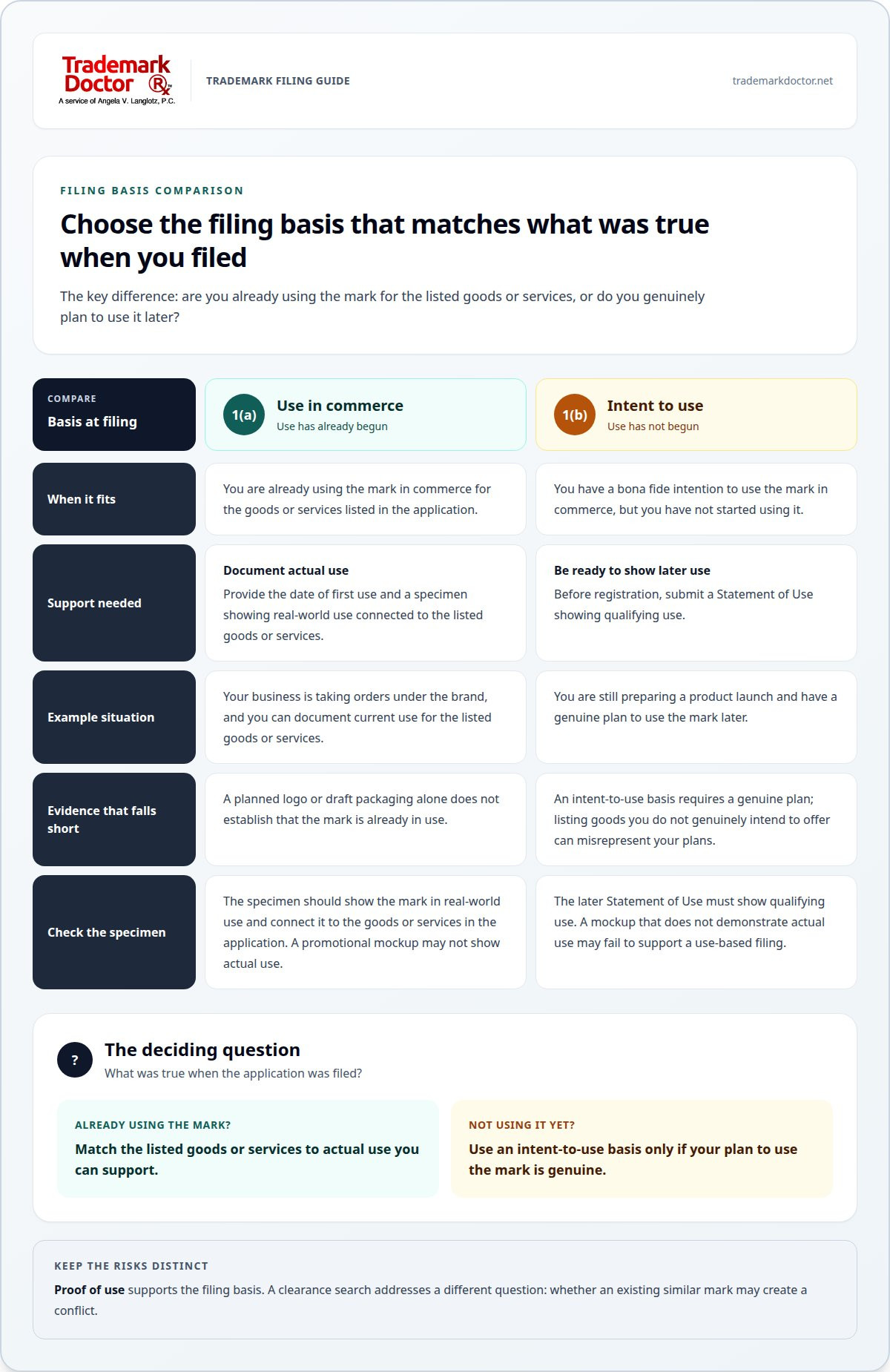
3. Choosing between use-in-commerce and intent-to-use filing bases
A professional selects Section 1(a) when the mark is already used in commerce for the listed goods or services. The application must include the date of first use and a specimen showing real-world use. Section 1(b) applies when you have a bona fide intention to use the mark in commerce but haven’t begun. Before registration, you must submit a Statement of Use showing qualifying use.
The deciding question is what was true when the application was filed. A business taking orders under its brand may have current use to document; one still preparing a product launch may need an intent-to-use basis. Compare the timeline, sales activity, and records supporting the claim to determine which basis fits. A planned logo or draft packaging alone doesn’t establish that the mark is already in use.
What specimens of use does the USPTO accept, and what specimen mistakes cause refusals? The specimen must show the mark in real-world use and connect it to the goods or services in the application. A professional checks whether the mark appears as claimed and whether the evidence supports the selected basis. A promotional mockup or image that doesn’t demonstrate actual use may fail to support a use-based filing.
Before recommending a filing basis, a trademark professional can conduct a clearance search across federal, state, and common-law records. This review addresses a different risk than proof of use: an existing similar mark may create a conflict even when your evidence is sound. An attorney can also review the application for complete, consistent information, including the selected class and basis.
Attorney-assisted filing brings legal review to decisions that a self-filed application leaves to you. The professional evaluates the facts and supporting evidence, then prepares the filing accordingly. The USPTO’s application requirements can vary with the filing details and selected classes, so completeness matters. A trademark availability evaluation can help identify potential conflicts before you proceed with the application.
4. Correction procedures by application stage
A professional first identifies the actual trademark owner, then compares that entity with the applicant named in the federal filing. If “Bright Star LLC” appears instead of “Bright Star Inc.,” the difference may involve separate legal entities, not a harmless typo. The key question is whether the same entity owned the mark before and after correction. The USPTO refers applicants to TMEP 1201.02(c) for guidance on name changes.
Before an application is assigned to an examining attorney, a voluntary amendment may correct eligible details. Obvious typographical errors in contact information can generally be amended. A trade name, a former name after a legal name change, or a clear clerical error may also support correction if the owner remains the same legal entity. A corporate affiliate or prior owner is different; replacing one with another generally cannot fix the original ownership error.
What happens if a trademark application has errors, and can you correct or amend it? Some details, such as contact typos, can be corrected, but material errors may require a new application. The USPTO may refuse amendments, and an applicant cannot use one to change the owner to a different entity.
What deadlines and response rules apply after the USPTO issues an office action? Respond by the deadline stated in the action; missing it can lead to abandonment. If a correction is also needed, submit it with the office-action response using the Response to Examining Attorney Office Action form.
Publication changes the process. After publication in the Trademark Official Gazette, an applicant-made error may be addressed through the Post-Approval/Publication/Post-Notice of Allowance Amendment form, subject to the USPTO’s rules. A basis change after publication requires a Petition to Director. For a USPTO clerical error, submit a written request within one week after publication. Get help responding to a trademark Office Action when a correction and response must be coordinated.
Trademark Doctor: Trademark application filing
Trademark Doctor helps you move from application decisions to a carefully prepared filing. Its trademark application filing can be useful when you need support aligning the applicant, mark, filing basis, and goods or services before submission.
If you’re assessing whether a mark may conflict with existing rights, a trademark availability evaluation can inform your filing decision. If the USPTO raises an issue during examination, Trademark Doctor handles Office Action responses. These services address different stages, from evaluating a mark before filing to responding to examination concerns.
Share the mark, ownership details, current or planned use, and the goods or services you want covered. This information helps shape the application around your actual business plans. Contact Trademark Doctor to discuss trademark application filing.
Make your next filing decision deliberate
Treat trademark protection as part of your business planning, not a last-minute form. Consider how the brand will be used as your offerings evolve, and ensure the ownership information reflects the entity responsible for protecting it. A focused conversation before filing can connect those business decisions to the application.
Trademark Doctor assists with trademark availability evaluation, application filing, and examination and Office Action responses. The right time to seek help depends on where you are in the process: before filing, while preparing the application, or after the USPTO raises an issue. Avoiding trademark application mistakes starts with grounding each decision in your actual plans.
When you’re ready to discuss the next step, contact Trademark Doctor. A clear plan can help you move forward with greater confidence.
Frequently Asked Questions
How can a professional help you avoid misrepresentation in a trademark application?
A professional can organize the information behind your application, including business records, product materials, and the mark’s actual use, so its statements have a factual basis. Before you retain counsel, remember that Trademark Doctor’s website provides general information only, AS IS, without warranties of merchantability, fitness for a particular purpose, or non-infringement. Website content isn’t individualized legal advice, and reading it doesn’t create an attorney-client relationship.
When can you amend a mistake?
The available correction method depends on the application’s status and the requested change. A correction that affects how an approved mark appears may require republication, giving others an opportunity to review the changed record. An amendment also cannot expand the goods or services originally identified. Assess the proposed change against the application record before selecting a filing procedure.
What if There Is Misrepresentation in My Trademark Application?
The effect depends on what was misstated and whether the applicant intended to deceive. A good-faith clerical mistake differs from knowingly making a false factual claim, but neither should be ignored once discovered. Preserve records showing what information was available when the application was prepared, such as dated product listings or business documents. These records can help explain how an inconsistency arose.
What are the most common mistakes when filing a U.S. trademark application?
Applicants often overlook how the mark’s presentation affects the application. For example, filing a logo when the business intends to protect wording alone may create a different scope of protection than expected. Inconsistent versions of the mark across packaging, websites, and application materials can also cause problems. Before filing, establish which version you’re claiming and keep the application materials consistent with it.
How can a professional search the USPTO database to avoid conflicts with existing trademarks?
A search result needs context, not just a name match. Evaluate the marks’ overall similarities alongside the relationship between their goods or services, since similar marks can raise different concerns depending on what they identify. Trademark Doctor’s process also includes searching online for unregistered users. This broader review can reveal uses that a federal database search alone may not show.
How can a professional identify the correct trademark owner and legal name for an application?
Review formation and ownership records, then trace any later transfer of trademark rights to the current owner. For example, if a business acquired a brand from another company, transfer documents may clarify who should apply. Document a legal name change, too, so the owner name in the application can be connected to the entity’s earlier records.