

A merely descriptive trademark refusal under Section 2(e)(1) means the USPTO believes your mark immediately describes a feature, quality, purpose, or other characteristic of your goods or services. You may be able to respond by explaining how consumers understand the mark, disclaiming descriptive wording, or presenting evidence that the mark has acquired distinctiveness. This guide explains how to assess those options and what a trademark professional considers when preparing a response.
Key Takeaways
- Assess whether consumers immediately understand the mark’s connection to the listed goods or services, or must make an imaginative leap.
- Consider whether evidence of consumer recognition could support an acquired-distinctiveness claim, and what that claim concedes.
- Determine whether a disclaimer could address descriptive wording without giving up the mark as a whole.
- Build the response around the examiner’s reasoning and the available evidence; the right approach may differ from one application to another.
What is a Merely Descriptive Trademark?
Assess the mark against the specific goods or services in your application. A merely descriptive trademark refusal under Section 2(e)(1) may apply when the mark immediately describes them.
-
Distinguish Suggestive and Descriptive Marks
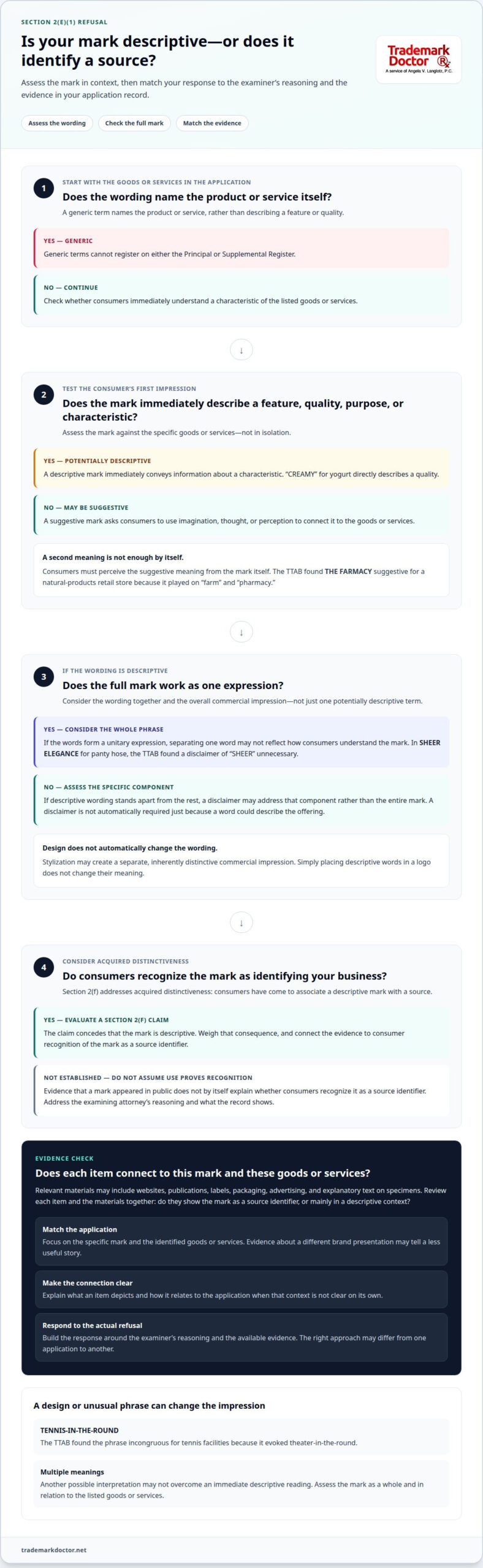
Ask whether consumers understand a product feature immediately or must make an imaginative leap. A merely descriptive trademark refusal under Section 2(e)(1) turns on that distinction in context. The Federal Circuit describes a mark as descriptive when it immediately conveys information about a product or service characteristic. A suggestive mark requires consumers to use imagination, thought, or perception. For example, “CREAMY” for yogurt directly describes a quality.
- Separate descriptive terms from generic names. A descriptive term identifies a quality or feature; a generic term names the product or service itself. Generic terms cannot register on either the Principal or Supplemental Register. To assess a refusal, review the evidence cited in the Office Action. The USPTO may rely on websites, publications, labels, packaging, advertising, or explanatory text on specimens.
-
Assess Marks With Multiple Meanings
Evaluate the mark as a whole and in relation to the identified goods or services. A phrase may suggest a second meaning, but consumers must perceive that meaning from the mark itself. For example, the TTAB found THE FARMACY suggestive for a natural-products retail store because it played on “farm” and “pharmacy.” Another possible interpretation may not overcome an immediate descriptive reading.
- Consider unusual wording and design elements before treating every descriptive word as decisive. The TTAB found TENNIS-IN-THE-ROUND incongruous for tennis facilities because it evoked theater-in-the-round. A design mark may also qualify if its stylization creates a separate, inherently distinctive commercial impression. Simply placing descriptive words in a logo does not change their meaning.
Acquired distinctiveness under Section 2(f)
- Assess whether consumers recognize your mark as identifying your business, not merely describing your goods or services. Section 2(f) addresses acquired distinctiveness: a descriptive mark may qualify when consumers have come to associate it with a source. But making this claim concedes that the mark is descriptive. Weigh that consequence before building the response around consumer recognition.
- Match each piece of evidence to the mark and goods or services in your application. The USPTO’s TMEP §1212 covers acquired distinctiveness, and relevant materials may include websites, publications, labels, packaging, and advertising. For example, a package showing the mark beside the product can help explain how buyers encounter it. Evidence about a different brand presentation may tell a less useful story.
- Show how the evidence supports recognition of the mark as a source identifier, rather than merely showing that it appeared in public. A website or advertisement can establish how you presented the mark, while explanatory text on a specimen may clarify its role. Organize the materials to make clear the connection between the mark, the identified goods or services, and consumer recognition.
- Compare the evidence with the refusal before relying on Section 2(f). If the examining attorney points to a specific descriptive meaning, address that reasoning and explain why consumers also recognize your mark as a source identifier. Keep the response focused on the application’s mark and listed goods or services. The right evidence depends on what the record actually shows.
Consider what each item does beyond documenting use: what does the surrounding material explain about the mark and its relationship to the goods or services in the application? A website, publication, label, packaging, advertisement, or explanatory text on a specimen may be considered in that assessment. Focus on the specific mark rather than assuming every appearance communicates the same thing. Make the connection between the evidence and the claim of consumer recognition easy to understand.
Review the materials both together and individually. Do they present the mark as an identifier of source, or mainly show it in a descriptive context? If an item needs explanation, use concise text to clarify what it depicts and how it relates to the application. A well-matched record makes the reasoning easier to follow. Materials unrelated to the mark or the identified goods or services may distract from the point.
Disclaimer of descriptive wording
- Identify the exact wording the examining attorney considers descriptive. A disclaimer may address a descriptive component rather than the entire mark. For example, if a mark combines distinctive wording with a term describing a product feature, determine whether the refusal targets that term or the complete expression. A concern about one component does not automatically resolve the status of the mark as a whole.
- Assess the wording in the context of the full mark and the identified goods or services. A disclaimer is not automatically required just because one word could describe the offering. In SHEER ELEGANCE for panty hose, the TTAB treated the phrase as a unitary expression and found a disclaimer of SHEER unnecessary. The example shows why the relationship between words matters.
- Compare the examiner’s reasoning with the mark’s overall commercial impression. If the descriptive wording stands apart from the rest, a disclaimer may address that component while the application proceeds with the complete mark. If the words work together as a single expression, consider whether separating one term would misrepresent how consumers understand the phrase.
- Choose a response that fits the refusal, rather than adding a disclaimer reflexively. The TTAB’s SHEER ELEGANCE decision illustrates that a descriptive interpretation of one word does not always settle the analysis of a phrase. A response can explain why the wording forms a unit or address the identified component through a disclaimer. The application’s wording and identified goods or services guide that choice.
How a Trademark Professional Can Respond to a Section 2(e)(1) Refusal
- Consider whether the Supplemental Register is a workable alternative. It can provide registration for some descriptive marks, but a generic term cannot register on either register. An intent-to-use application needs an allegation of use on file before it can be amended to the Supplemental Register.
- Start with the examiner’s specific reasoning and the application record. For a merely descriptive trademark refusal under Section 2(e)(1), a professional compares the mark with the identified goods or services and pinpoints whether the refusal rests on wording, context, or evidence. An argument about a double meaning should explain how consumers would perceive it from the mark itself.
- Put the strongest supported arguments in the first response. A response to a merely descriptive trademark refusal under Section 2(e)(1) may explain why the mark is suggestive, address how the complete phrase creates a distinct impression, or present evidence of acquired distinctiveness. A disclaimer may address a descriptive component when that approach fits the mark. Each argument should answer the examiner’s actual basis for refusal.
- Weigh the Supplemental Register’s benefits against its limits. A registration there permits use of the ® symbol, may be cited against later confusingly similar applications, and supports a federal infringement suit. However, it lacks the presumption of validity and ownership associated with the Principal Register and cannot become incontestable.
- If the examining attorney maintains the refusal, assess reconsideration or appeal in light of the record and the response already filed. A trademark professional can identify which arguments remain persuasive and whether the evidence supports continuing the challenge. Earlier strategy matters: later proceedings rely on the application record, so a limited first response may leave less room to strengthen the position.
Trademark Doctor
Trademark Doctor helps you assess a Section 2(e)(1) refusal and consider a response that fits your application. The strategy should match the examiner’s reasoning, your mark, and the goods or services listed.
If the Office Action questions how consumers understand your wording, a response can address that issue directly. If it focuses on one component, a disclaimer may be relevant. Questions in the application record about how the mark was presented or which goods or services are identified can also shape the analysis.
Trademark Doctor provides trademark examination and Office Action responses, as well as trademark availability evaluations and application filing. When a refusal follows an application, reviewing the Office Action alongside the application materials helps put the examiner’s concerns in context.
Consider professional help if the refusal’s reasoning is unclear, the record needs careful analysis, or you’re weighing response options. Trademark Doctor’s team has relevant experience assessing refusals and response options without promising a particular registration outcome.
Contact Trademark Doctor to discuss your Section 2(e)(1) refusal.
Frequently Asked Questions
What is a merely descriptive trademark under Lanham Act Section 2(e)(1)?
A merely descriptive mark is one the USPTO considers unable to distinguish the applicant’s goods or services because of its descriptive meaning. The practical question is how the wording functions for the specific items named in the application. For instance, a word describing a product’s material may be descriptive for that product, while the same word could play a different role for unrelated services.
How does the USPTO determine whether a mark is merely descriptive?
The examiner evaluates the mark in connection with the goods or services identified in the application, not in isolation. A term’s meaning can change with that context. For example, “COLD” could describe a characteristic of a beverage, while its meaning for a different type of service may not be immediately apparent. The Office Action explains how the examiner applied the mark to your application.
How can a trademark attorney respond to a merely descriptive trademark refusal?
A trademark attorney can examine the wording of the refusal, the application’s identification, and the existing record before selecting a response. The attorney can also flag whether changing the identification could affect the analysis, since the listed goods or services shape the issue. Your response should address the examiner’s specific reasoning and preserve the arguments that best fit the application.
Can a descriptive trademark gain distinctiveness through acquired distinctiveness under Section 2(f)?
Yes, a mark may qualify under Section 2(f) when the evidence supports consumer recognition of it as a source identifier. The materials should connect the mark to the relevant goods or services and show how it appears in actual brand use. A collection of advertisements, product labels, and website pages may help tell that story when the mark appears consistently and prominently.
What are common examples of marks refused as merely descriptive?
“1-TAP” has been treated as descriptive for mobile-device software when it means touching the screen one time. The example illustrates why an examiner may focus on what a term communicates about a function. Similar issues can arise with wording that directly describes a service feature, such as “FAST DELIVERY” for a delivery service, though that phrase is an illustration, not a reported refusal.
What deadlines apply to responding to a USPTO Section 2(e)(1) refusal?
Use the response deadline stated in your USPTO Office Action and plan your filing around it. The appropriate path depends on whether you are answering an initial refusal or addressing one the examining attorney has maintained. If the refusal remains, an applicant may seek reconsideration or appeal. Review the notice carefully to ensure your response addresses every outstanding issue.