

In the supplemental register vs. principal register comparison, the Principal Register provides stronger legal presumptions of ownership and exclusive nationwide rights, while the Supplemental Register offers a federal registration option for marks in lawful commercial use that do not yet qualify for the Principal Register. If your mark is on the Supplemental Register, moving to the Principal Register requires a new application and evidence of acquired distinctiveness; five years of use alone does not establish eligibility.
This guide explains how marks qualify for each register, what the Supplemental Register provides, and how to assess a possible move between registers.
Key Takeaways
- Assess whether your mark is inherently distinctive, descriptive, or generic; that classification shapes which federal register may be available.
- A Supplemental Register registration can provide federal benefits, but it does not carry the same legal presumptions as a Principal Register registration.
- Compare the protections each register provides with your brand’s current use and long-term goals before choosing an application path.
- Trademark application preparation and examination support can help you address register eligibility and respond to USPTO issues.
How Can Marks Qualify for the Principal Register?
The USPTO requires a mark to be distinctive to qualify for the Principal Register. Arbitrary, fanciful, and suggestive marks are inherently distinctive. A descriptive mark needs acquired distinctiveness: consumers must associate it with particular goods or services and recognize their source. Generic terms identify a product category, so they cannot function as trademarks.
Use matters, too. To register a mark on the Principal Register, it must be in use in commerce when registered. A mark that lacks distinctiveness may qualify later if its use builds the necessary consumer association. For a descriptive mark, at least five years of exclusive and continuous use may support acquired distinctiveness, but five years alone may not be enough.
Incontestability is a separate milestone, not an automatic result of registration. A Principal Register owner may apply for incontestable status after five years of continuous use following registration. That status can strengthen a registration, but it does not eliminate every possible challenge. A Principal Register registration more than five years old can be challenged only in limited circumstances. A Supplemental Register mark cannot gain incontestable status after five years of use.
| Register | Distinctiveness and use | Incontestability |
|---|---|---|
| Principal | Distinctive mark; in use in commerce when registered | May apply after five years of continuous use following registration |
| Supplemental | Mark in lawful commercial use that does not qualify for the Principal Register | Cannot gain incontestable status after five years of use |
Choose based on the mark’s distinctiveness, commercial use, and evidence of acquired distinctiveness. The five-year period does not replace that evidence.
Distinctiveness requirements for the Principal Register
The supplemental register vs. principal register question also depends on how clearly your filing connects the mark, its use, and the listed goods or services. A focused record helps show what consumers encounter in the marketplace.
Distinctiveness and Register Eligibility
For a use-in-commerce application under Section 1(a), a substitute or additional specimen must have been in use at least as early as the application filing date. Keep the filing details aligned: the mark shown in the specimen should match the mark in the application, and the specimen should relate to the identified goods or services. If the application lists several products, evidence tied to only one may not address every listed item.
Acquired Distinctiveness and Secondary Meaning
Evidence is most useful when it addresses the precise mark and goods or services in the application. A declaration should make clear which wording consumers recognize and what products or services that recognition concerns. For example, if your application covers two product lines, explain the evidence for each line separately rather than treating them as interchangeable. Specificity makes the connection easier to evaluate.
Distinctiveness Through Continued Use
Keep a consistent record of the mark as customers see it. If a business changes its logo or adds wording, older materials may show a different presentation from the mark in the current filing. That difference can make the evidence harder to assess. Before submitting materials, organize them by mark version and product or service category. This gives the application a clearer account of how the mark appears in commerce.
Supplemental Register benefits
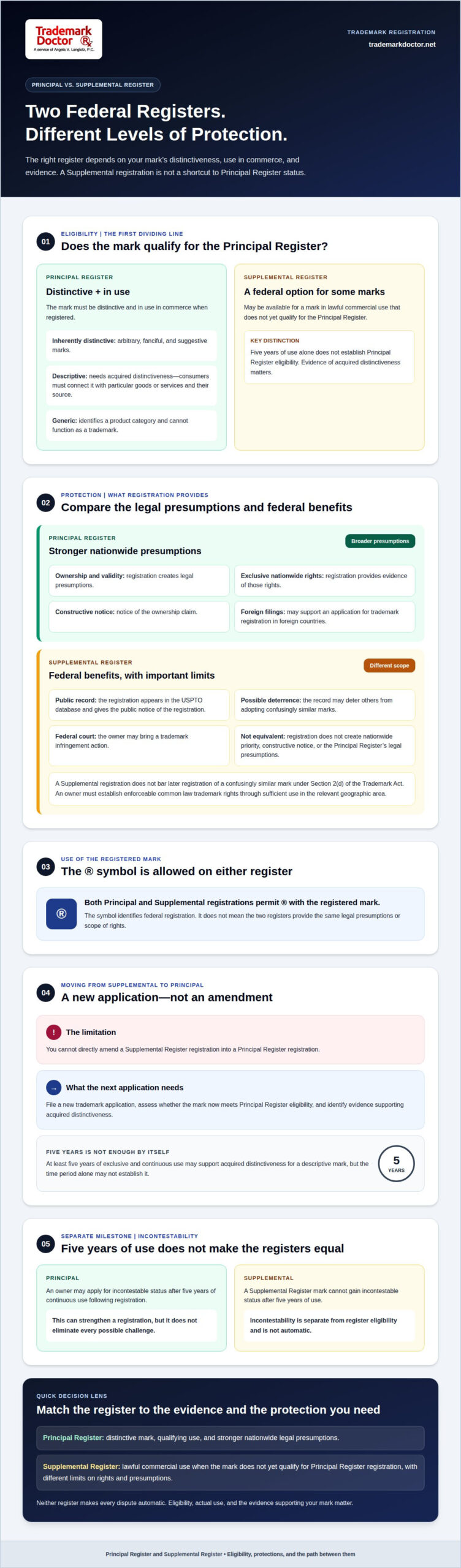
The Principal Register offers benefits the Supplemental Register does not. It creates presumptions of ownership and validity, and provides evidence of exclusive nationwide rights to use the mark. It also gives constructive notice of the ownership claim. These presumptions can strengthen your position if another business adopts a confusingly similar mark.
Can a Supplemental Register trademark use the ® symbol? Yes. Registration on either the Principal or Supplemental Register permits you to use ® with the registered mark. The symbol identifies federal registration, but it does not mean both registers provide the same legal presumptions or scope of rights.
The Supplemental Register still offers meaningful federal protections. Its registration is listed in the USPTO database, which gives the public notice of the registration and may deter others from adopting confusingly similar marks. However, Supplemental Register registration does not bar later registration of a confusingly similar mark under Section 2(d) of the Trademark Act. A Supplemental Register owner may bring a trademark infringement action in federal court.
Principal Register registration carries broader presumptions. It provides evidence of nationwide exclusive rights and ownership, and constructive notice that the owner claims the mark. A Principal Register registration may also support an application for trademark registration in foreign countries. These advantages can matter when establishing the mark’s legal standing beyond its appearance in the federal database.
Neither register makes every dispute automatic. A Supplemental Register owner must establish enforceable common law trademark rights through sufficient use in the relevant geographic area; registration itself does not create nationwide priority or constructive notice. For example, a local business may rely on its actual use to establish rights in its market, while the Principal Register gives its owner stronger nationwide presumptions. Choose the register that fits your mark’s eligibility and the protection you need.
Applying from the Supplemental Register to the Principal Register
You cannot directly amend a Supplemental Register registration into a Principal Register registration. You must file a new trademark application. Before filing, determine whether the mark now meets the Principal Register’s eligibility standard and identify the evidence supporting the application. The supplemental register vs. principal register choice is therefore a new filing decision, not a simple update to an existing registration.
A Supplemental Register registration may support a new application based on acquired distinctiveness after five years of registration. That timing does not establish eligibility by itself. Organize evidence around the mark, the listed goods or services, and how consumers encounter the mark. Keep the application details consistent with those materials so the examiner can assess the claim clearly.
Filing requirements depend on the application’s basis. A use-in-commerce application requires the mark to be lawfully used with the identified goods or services. An intent-to-use application is not eligible for the Supplemental Register until you submit an acceptable allegation of use. Consider these requirements when planning an application or deciding which register to request.
After filing, review any USPTO Office Action carefully. The examiner’s stated concern determines what the response must address, such as evidence or application wording. A response should connect its explanation to the existing application record, not introduce unrelated material. If the issue concerns the specimen, for example, address how it shows the mark in use with the identified goods or services.
Plan a transition around eligibility, evidence, and the new filing. Do not assume registration on the Supplemental Register automatically advances to the Principal Register or creates incontestable status. A clear record helps explain why the mark qualifies and what the application seeks. If the evidence does not yet support the move, continued use can help build a stronger record for a later filing.
Trademark Doctor
Trademark Doctor helps turn register differences into a practical filing decision. If you’re weighing an existing mark or planning a new trademark application, consider whether the mark qualifies, what evidence supports that position, and which register fits its current use. Trademark Doctor’s trademark services address these issues through availability evaluation, application filing, and examination support.
A trademark availability evaluation can help identify existing marks that may affect your filing strategy. For example, a descriptive mark may need evidence of acquired distinctiveness to qualify for the Principal Register, while a mark already in use might qualify for the Supplemental Register. Reviewing the mark, its goods or services, and its use together helps clarify which application path makes sense.
Once you select a filing approach, trademark application filing puts the proposed mark and its identified goods or services before the USPTO. Details matter. A mismatch between the mark, the listed goods or services, and the evidence of use can raise examination issues. Careful preparation gives the application a clearer foundation without promising a particular registration outcome.
If the USPTO issues an Office Action, the examiner has raised an issue that needs a focused response. Trademark Doctor handles examination issues and Office Action responses, addressing concerns raised during review. This support can be useful when the examiner questions the mark’s distinctiveness, the application’s wording, or another filing detail. The right response depends on the issue and the application record.
For a mark on the Supplemental Register, the practical next step may be an eligibility review, a new application, or a response to an examination issue. Trademark Doctor can help assess those options and handle the filing work that fits your situation. If you’re ready to discuss your mark and next steps, contact Trademark Doctor.
Frequently Asked Questions
What Are the Basic Criteria for Registering a Trademark on the Supplemental Register?
A mark must be lawfully used in commerce with the goods or services named in its application. The Supplemental Register may suit a descriptive mark that cannot yet qualify for the Principal Register, but generic wording cannot function as a trademark. If you filed an intent-to-use application, you must first submit an acceptable allegation of use before seeking Supplemental Register registration.
What Are the Key Differences between the Principal and Supplemental Registers?
The Principal Register provides presumptions of ownership and exclusive nationwide rights; the Supplemental Register does not. Both registrations appear in the USPTO database, permit use of the ® symbol, and can support a federal trademark infringement lawsuit. When comparing the registers, consider whether you need the Principal Register’s legal presumptions or whether Supplemental registration fits your mark’s current eligibility.
Still Confused About the Two Registers?
Start with the examiner’s issue and your mark’s current use. If the mark is distinctive, the Principal Register may be available; if it is descriptive but in lawful use, the Supplemental Register may be an option. This information is general only, provided AS IS and without warranties of merchantability, fitness for a particular purpose, or non-infringement. It is not individualized legal advice. Retain an attorney for advice about your situation.
What is the difference between the USPTO Principal Register and Supplemental Register?
Both are federal trademark registers maintained by the USPTO, not separate state and federal systems. The Principal Register carries legal presumptions that the Supplemental Register lacks. A practical difference arises when another business adopts a similar name: Principal registration provides stronger nationwide presumptions, while a Supplemental registrant generally must establish enforceable rights through use in the relevant geographic area.
What are the eligibility requirements for the Principal Register?
A mark must distinguish your goods or services from others. Arbitrary, fanciful, and suggestive marks can qualify as inherently distinctive; descriptive wording needs evidence of acquired distinctiveness. Generic terms, such as the product category itself, cannot qualify. For example, a mark that describes a product’s feature faces a different eligibility test from an unrelated brand name that identifies its source.
Which trademarks can be registered on the Supplemental Register?
A mark in lawful commercial use may qualify for the Supplemental Register when it does not meet the Principal Register’s distinctiveness standard but can still identify a source. Descriptive terms, including primarily geographic descriptions or surnames, may be considered for this register. Generic terms remain ineligible. For an intent-to-use application, registration on the Supplemental Register must wait until you submit an acceptable allegation of use.