
You may be able to revive an abandoned U.S. trademark application if you unintentionally missed a deadline. An abandoned application is no longer active and cannot proceed to registration unless revived, so first identify why it was abandoned.
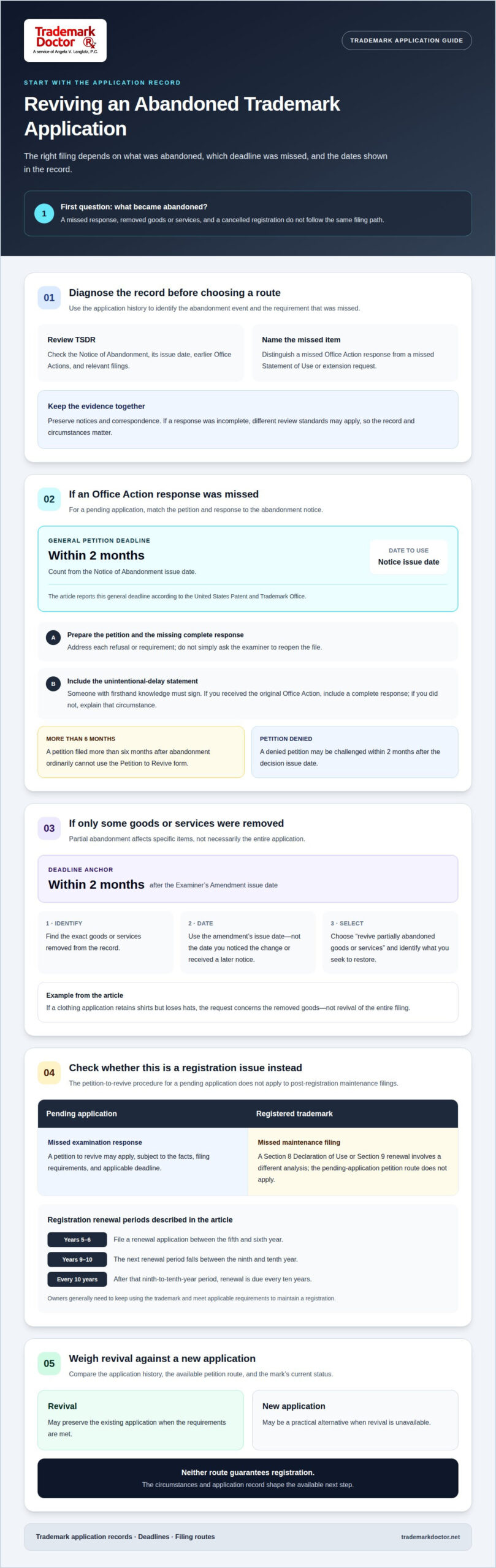
For a missed Office Action response, a petition to revive is generally due within two months after the Notice of Abandonment issue date, according to the United States Patent and Trademark Office.
Knowing how to revive an abandoned trademark application starts with distinguishing a missed response from an incomplete response or partial abandonment. This guide covers the relevant deadlines and petition requirements, and explains when trademark counsel can help assess the application record.
Key Takeaways
- Identify what caused the abandonment first; a missed response and an incomplete response may require different procedures.
- Gather the application record and the documents needed to address the missed requirement before a revival petition is prepared.
- For goods or services removed from an application, the route to request reinstatement differs from reviving the entire application.
- A trademark professional can assess the application’s status and prepare the filing steps that fit the abandonment issue.
Can a trademark professional revive my abandoned trademark application?
Sometimes. The available procedure depends on why the application became abandoned and which deadline or response was missed.
-
Have a professional check why the application was abandoned
Ask a professional to review the application record in TSDR and identify the abandonment event. The Notice of Abandonment, its issue date, and earlier Office Actions or filings help establish what happened. A professional traces those records rather than assuming every abandoned application followed the same path. Preserve relevant notices and correspondence as evidence. This record review is the starting point for assessing available options.
-
Have a professional identify the missed response or filing deadline
Distinguish a missed Office Action response from a missed Statement of Use or extension request. For a missed Office Action deadline, a petition to revive is generally due within two months after the Notice of Abandonment issue date, according to the United States Patent and Trademark Office. A missed Statement of Use or extension deadline follows a separate filing path. If a response is incomplete, different review standards may apply, so the next step depends on the circumstances.
-
Have a professional file the petition to revive
Have the professional prepare the petition, the missing complete response or filing, and a statement that the delay was unintentional. Someone with firsthand knowledge must sign that statement. If you received the original Office Action, include a complete response; if you didn’t, explain that circumstance. These details shape how to revive an abandoned trademark application based on its specific record. A petition filed more than six months after abandonment ordinarily cannot use the Petition to Revive form. A denied petition may be challenged within two months after its decision issue date.
-
Compare revival with a new application with a trademark professional
Compare the reason for abandonment, the available petition route, and the proposed mark’s current status. Revival may preserve the existing application when requirements are met; a new application may be a practical alternative when revival is unavailable. Either choice requires attention to the application’s history and the mark’s present circumstances. Neither route guarantees registration.
Reviving an application abandoned after a missed office-action deadline
For a pending application, focus first on the missed examination deadline. Registration maintenance is a separate process with different filings and consequences.
- Have an attorney match the abandonment notice to the missed Office Action. According to the United States Patent and Trademark Office, a petition to revive after a missed response deadline is generally due within two months after the Notice of Abandonment issue date. The petition must state that the delay was unintentional and include the complete response if you received the Office Action. The response should address each refusal or requirement, not simply ask the examiner to reopen the file.
- Separate an application deadline from a registration maintenance deadline. If a response deadline passed and the application was abandoned, the petition process may apply. But a registration can be cancelled for failure to file required maintenance documents, including a Section 8 Declaration of Use or a Section 9 renewal. The petition-to-revive procedure for pending applications does not apply to Office Actions involving those post-registration filings. A notice concerning a registration therefore calls for a different analysis.
- Track every renewal period in a permanent calendar, with reminders tied to the registration record. In the United States, owners file a renewal application between the fifth and sixth year, then between the ninth and tenth year. After that ninth-to-tenth-year renewal period, renewal is due every ten years. Owners generally need to keep using a trademark and meet applicable requirements to maintain a registration. Missing a date can put the registration at risk of cancellation.
- Act on the specific notice, not a generic deadline reminder. Record the notice date, the filing at issue, and any response deadline stated in the document. A denied petition or a registration cancellation may require a different next step from an abandoned pending application. For examination-related filings, trademark examination and Office Action responses can help address the specific refusal or requirement in the application record.
Reviving goods or services in a partially abandoned application
Partial abandonment affects specific goods or services, not necessarily the entire application. Its filing route and deadline differ from those for reviving a fully abandoned application.
- Review the abandonment record to identify the affected goods or services. In the United States, partial abandonment may follow an Examiner’s Amendment that removes items from the application. The amendment’s issue date controls the petition deadline. For example, if a clothing application retains shirts but loses hats, the request concerns the removed goods, not the entire filing.
- Calculate the deadline from the Examiner’s Amendment issue date. A petition to revive partially abandoned goods or services is due no later than two months after that date. Don’t use the date you noticed the change or received a later notice instead. The filing must address the specific situation shown in the application record, so the affected wording and amendment date need to match.
- The filing route should match the partial-revival request. In step 3, select “revive partially abandoned goods or services.” The requested remedy is focused: identify the goods or services to restore and submit the petition within the applicable window. This is not the same as asking to revive an entire application after missing an Office Action response deadline.
- Consider how the filing may affect other businesses assessing the mark. A third party considering a dead trademark may find an application for goods or services identical to, or narrower than, those in a cancelled registration relevant. For example, a business evaluating a mark for hats may care whether the pending application covers hats, even if other goods were removed. A partial-revival request can change which goods or services remain at issue, so the record matters to both the applicant and later reviewers.
Reviving an abandoned trademark application
An abandoned application is no longer active and cannot proceed to trademark registration unless revived. The right path depends on the missed filing, the application’s basis, and its record. Start by matching the requested remedy to the reason the application became inactive.
- Identify the precise reason for abandonment before choosing a filing. A missed Office Action response, an incomplete response, and a missed Statement of Use deadline are different situations. The USPTO petition form addresses qualifying failures to respond, while incomplete responses follow a separate review standard. A petition cannot cure every defect, so assess how to revive an abandoned trademark application based on the record rather than treating every abandonment alike.
- For an intent-to-use application, map each Notice of Allowance deadline. A Statement of Use is due within six months after the notice, and each extension request adds six months. An applicant may request up to five extensions, but the Statement of Use must be filed within three years after the Notice of Allowance. A petition to revive does not extend that three-year period or future Statement of Use deadlines.
- Check whether deleting the intent-to-use basis could preserve another filing basis. For an application with multiple bases, the alternate basis must already appear in the application. A petition form allows an applicant to request deletion of the Section 1(b) basis or intent-to-use goods or services after a Notice of Allowance. That option depends on the existing record; it does not create a missing basis.
- If the USPTO denies or dismisses a petition, consider review promptly. A request for reconsideration must be filed no later than two months after the petition decision issue date. The filing should address the decision’s stated reason and include relevant evidence or documents. Request a professional application review to assess the record and possible next step.
Trademark Doctor: Trademark application filing
Trademark Doctor helps assess abandoned applications and determine whether the filing record supports a revival request or another next step. If the application remains eligible for revival, its trademark examination and Office Action response services can address missed requirements. If a new filing is the better way to protect the mark, Trademark Doctor also handles trademark application filing.
A trademark availability evaluation can help assess a mark before filing a new application. The right approach depends on the reason for abandonment, the application record, and the goods or services involved. Trademark Doctor also handles Online Intellectual Property Issues related to brand protection.
Contact Trademark Doctor for help assessing your trademark application.
Make your next brand-protection decision with a clear record
An abandoned application can affect more than a line in a USPTO database; it can disrupt plans for a name, logo, or product launch. Before taking another step, decide what protection your business needs now and how the mark fits the goods or services you actually offer. Learning how to revive an abandoned trademark application is not only about reopening a file; it’s also about making a deliberate plan for the brand from this point forward. Preserve notices, filings, and dated correspondence so your next decision reflects the application history. Base that decision on the names you use, the products you sell, and documentation of those uses. This alignment helps keep future trademark work focused.
Trademark Doctor’s trademark attorney can review the circumstances and explain the options supported by the record. The appropriate path depends on the filing’s procedural history and the protection you seek, so don’t treat a revival request as a guaranteed route to registration. A careful assessment can also help you decide whether to focus on the existing application or plan a new filing.
Contact Trademark Doctor for help with your next trademark step. Move forward with a clear view of your brand’s needs and a practical plan to protect them.
Frequently Asked Questions
What is a “dead” trademark?
“Dead” is an informal label for a trademark application that is no longer active or a registration that has been cancelled. The label describes the federal record, not necessarily whether a business still uses the name. For example, a dead application doesn’t establish that a mark is available for your business; a separate trademark search can reveal potential conflicts.
What does abandoned status mean for a U.S. trademark application?
Abandoned status means the application is no longer active and cannot proceed to registration unless revived. It does not, by itself, establish whether the applicant continues using the mark in commerce. For example, a business may still sell products under its name while its application is abandoned. The application’s procedural status and the business’s real-world use are separate questions.
What is the deadline to revive an abandoned USPTO trademark application?
After a missed Office Action response, a petition is generally due within two months after the Notice of Abandonment issue date, according to the United States Patent and Trademark Office. If you didn’t receive that notice, the petition must be filed within two months after learning of the abandonment and no later than six months after the abandonment date in TSDR. Promptly determine which situation applies.
What forms and evidence are required to revive a trademark application after missing a USPTO deadline?
A qualifying missed Office Action deadline generally calls for the USPTO’s petition-to-revive form, the complete response or missing document, and a statement that the delay was unintentional, signed by someone with firsthand knowledge. If you didn’t receive the Office Action, the petition should address that fact. Preserve dated notices and correspondence to support your account.
Can I revive an application abandoned for failure to respond to an Office Action?
Yes, if you unintentionally missed the response deadline and meet the petition requirements. When you received the Office Action, the filing must include a complete response; a petition alone doesn’t answer the examiner’s requirements. If you never received the Office Action, the petition should explain that circumstance and include the response you are now submitting. The application record and timing matter.
How do I revive an intent-to-use application abandoned for missing a Statement of Use deadline?
File a petition that includes the required Statement of Use or an extension request and a statement that the delay was unintentional. A Statement of Use is due within six months after a Notice of Allowance, with up to five extension requests available. The filing period cannot extend beyond three years after that notice. This site’s information is general, provided “AS IS” without warranties; consult a licensed attorney for advice on your circumstances.