

A place name alone doesn’t doom a trademark application. A geographically descriptive trademark refusal generally depends on whether consumers connect a known location with the goods or services and understand the name as indicating their origin.
That distinction matters because an accurate geographic description may follow a different path from a false suggestion of origin, and a refusal under Section 2(e)(2) may be challenged with evidence or a Section 2(f) acquired-distinctiveness claim, which continuous use for five years may support but does not prove by itself.
A refusal can feel like a dead end, but the next step depends on the examining attorney’s reasoning and the evidence in your application. This article explains how geographic significance is assessed, when acquired distinctiveness may help, and what response options may be available.
Key Takeaways
- A geographic place name doesn’t automatically block registration; the key issue is how consumers understand its connection to your goods or services.
- Evidence of acquired distinctiveness may help show that consumers recognize a descriptive mark as identifying your brand, not just a location.
- The Principal Register and Supplemental Register offer different paths, with eligibility depending on the mark and its use.
- Your response can challenge the examiner’s reasoning or present evidence supporting registration; the best approach depends on the basis for refusal.
What is acquired distinctiveness?
Acquired distinctiveness may help when a geographic term initially describes a place rather than a brand. The key question is whether consumers now recognize the term as identifying your goods or services.
Acquired Distinctiveness and Secondary Meaning
Acquired distinctiveness, also called secondary meaning, means consumers understand a descriptive mark as identifying a particular source. “Secondary” distinguishes that source-identifying meaning from the mark’s original geographic meaning. For example, buyers might first read a place name as indicating where goods originate. If they come to recognize it as one business’s brand, they may instead associate it with that source.
Acquired Distinctiveness Under Section 2(f)
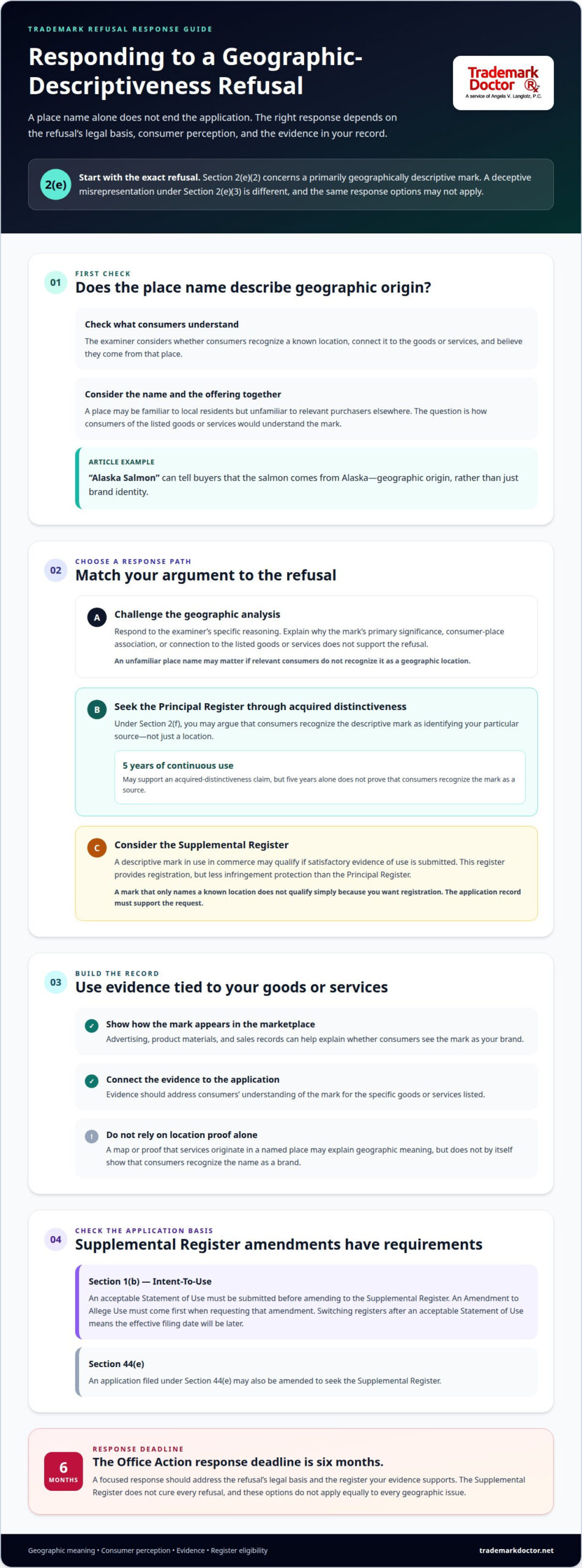
Section 2(f) of the U.S. Trademark Act allows an applicant to argue that a descriptive mark has become distinctive through use. A mark with acquired distinctiveness may qualify for the principal register, even when its wording began as geographically descriptive. Continuous use for at least five years may support an acquired-distinctiveness claim. Five years alone, however, does not establish that consumers recognize the mark as a source.
The trademark office considers whether the evidence connects consumers’ understanding to your specific goods or services. An attorney can assess how the mark appears in advertising, product materials, and sales records, then relate that evidence to the application. A map or proof that services originate in a named place may explain its geographic meaning, but doesn’t by itself show that consumers recognize it as a brand. The response should address the examiner’s concern directly.
Keep the legal distinction clear. A mark that falsely suggests goods or services come from a place may face a different kind of refusal, and acquired distinctiveness may not resolve it. Section 2(f) is relevant to a primarily geographically descriptive refusal under Section 2(e)(2), not a deceptive misdescription under Section 2(e)(3). Your response depends on which ground the examiner applied and what the evidence shows.
Geographically Descriptive Trademark Rejection | What Can I Do?
A refusal under Section 2(e)(2) does not always end a trademark application. Your options may include challenging the examiner’s geographic analysis, seeking registration on the Supplemental Register, or establishing eligibility for the Principal Register through distinctiveness.
The Principal Register is the stronger federal registration path for a mark that qualifies. A primarily geographically descriptive mark may become eligible when it has acquired distinctiveness for the listed goods or services. The Supplemental Register offers another possibility for a mark that remains descriptive. It provides registration, but less infringement protection than the Principal Register. Neither register erases the practical difference between a place name and a source-identifying brand.
To qualify for the Supplemental Register, a geographically descriptive mark must be used in commerce, and satisfactory evidence of use must be submitted to the trademark office. A mark that only names a known geographic location doesn’t qualify simply because the applicant wants registration. The application record must support the requested register. An applicant may also respond to an Office Action with evidence and arguments that address the examiner’s specific reason for refusal.
Amendment procedures depend on the application basis. If you filed under Section 1(b), an Intent-To-Use basis, you must submit an acceptable Statement of Use before amending to the Supplemental Register. For a Section 1(b) application, an Amendment to Allege Use must come first when requesting that amendment. Once an acceptable Statement of Use is submitted, the application’s effective filing date will be later if you switch registers. An application filed under Section 44(e) may also be amended to seek the Supplemental Register.
These options do not apply equally to every geographic refusal. A deceptive misrepresentation is different from an accurate geographic description, and the Supplemental Register does not cure every refusal. The Office Action response deadline is six months. A focused trademark Office Action response can address the refusal’s legal basis and the register your evidence supports.
Geographic significance and consumer-place association
A geographic term matters when consumers connect it to a known place and the goods or services. The USPTO assesses the mark’s primary significance, consumer association, and geographic origin.
Consumer Perception of Geographic Origin
Consumer perception links a place name in a mark to where the goods or services originate. For a primarily geographically descriptive refusal, the examiner considers whether consumers are likely to associate the goods or services with the named location and believe they come from there. “Alaska Salmon” illustrates the connection: the name describes salmon from Alaska. The geographic term communicates origin, not just brand identity.
Obscure or Unfamiliar Geographic Names
A geographic name that consumers don’t recognize as a place may lack the primary significance of a generally known geographic location. That matters because recognition of the location is part of the descriptiveness analysis. If consumers don’t know the place name, the examiner must still establish its relevant geographic meaning and the consumer-place association.
A place may be familiar to residents but unfamiliar to relevant purchasers elsewhere. The test concerns consumers of the goods or services in the application, not simply whether the name appears on a map. The mark’s wording and the goods or services together shape whether buyers would connect it with a known geographic location.
Evidence of Geographic Descriptiveness
The USPTO evaluates whether the mark primarily identifies a known geographic location, whether consumers would associate the goods or services with it, and whether they originate there. The examining attorney must establish a prima facie case for a geographic refusal. The evidence must support the relevant factors, not merely show that the place exists.
In In re Zeller, Serial No. 77544307, the Board reversed a refusal of CATALINA ISLAND GRANOLA & Design because the record did not establish a goods-place association. Compare that result with THE NASHVILLE NETWORK, used for television program services originating in Nashville. These examples show why the relationship between the named place and the particular goods or services can decide the analysis.
Options for responding to a geographic-descriptiveness refusal
A strong response addresses the examiner’s stated ground, not geography in the abstract. First, identify whether the refusal says the mark is primarily geographically descriptive or geographically deceptively misdescriptive. Those grounds raise different questions. Then assess whether the record supports the place’s significance, consumers’ likely association, and the connection to the listed goods or services.
If the examiner calls the mark primarily geographically descriptive, the response can challenge a weak link in that analysis. For example, argue that the place isn’t generally known or that consumers wouldn’t connect it with the particular goods or services. The examining attorney must establish a prima facie case. A focused response can identify where the evidence fails to support a required part of the analysis.
Next, match the evidence to the disputed point. If the refusal relies on an association between the goods and the place, the record should address whether purchasers regard that location as a known source for those goods. For services, explain the consumer connection to the place rather than relying only on the business address. A composite mark may also matter if its other wording or design creates an inherently distinctive impression. Adding generic or descriptive wording alone doesn’t necessarily change the mark’s primary geographic significance.
Can disclaiming a geographic term overcome the refusal? Usually, a disclaimer alone doesn’t change the mark’s overall primary significance or resolve the geographic basis. It may address rights in a particular component, but the refusal still needs a response to its underlying reasoning.
For a geographically deceptively misdescriptive refusal, a disclaimer does not fix a false origin implication. The response must address the examiner’s basis for finding that consumers would believe the goods or services originate in the named place. The USPTO response deadline is six months from the Office Action. Choose arguments and evidence that fit the exact refusal, and get help responding to a geographic refusal when the record or legal distinction needs careful analysis.
Trademark Doctor
Trademark Doctor helps assess geographic refusals and clarify what the examining attorney is questioning. If an Office Action challenges your mark’s geographic significance, the response should address the specific reasoning and evidence in the application record. Trademark Doctor handles trademark examination and Office Action responses, including evaluating whether the record supports an argument for registration or another available path.
Support can begin earlier, too. A trademark availability evaluation may identify geographic concerns before you file, while trademark application filing can help present the mark and its goods or services clearly. The right time to seek help depends on where you are in the process: before filing, during examination, or after receiving an Office Action.
Contact Trademark Doctor to discuss your geographic trademark refusal.
Make your next brand decision deliberately
Your brand name will keep working for your business long after this application stage. Consider how you want customers to recognize it as your products, services, and markets evolve. A geographically descriptive trademark refusal can prompt you to think beyond registration and make sure your naming choices support the brand you’re building.
Trademark Doctor can discuss your situation and help you consider a practical next step. A thoughtful decision now can give your brand clearer direction as your business grows.
Contact Trademark Doctor to discuss your refusal and move forward with greater clarity.
Frequently Asked Questions
What are examples of marks that were not primarily geographically descriptive?
A mark with a distinctive element beyond a place name may create a different overall impression. For example, a hypothetical coined brand name paired with a town name could be assessed as a whole, rather than as the town name alone. The added wording must contribute distinctiveness; simply appending generic product terms may leave the geographic meaning unchanged.
What is a primarily geographically misdescriptive mark?
It’s a mark that falsely suggests a geographic origin for goods or services. In In re Premiere Distillery, LLC, the Board affirmed a refusal of REAL RUSSIAN vodka because the vodka didn’t come from Russia, and Russia’s association with vodka made that false suggestion material to purchasing decisions. The case illustrates why perceived origin can matter to buyers.
What is a geographically descriptive trademark under U.S. law?
It’s a mark whose geographic wording describes the place connected with the listed goods or services. The practical issue is how the wording functions for the specific items named in your trademark application. A place name may describe the source of one product yet have a different significance for unrelated goods. Assess the full mark alongside the application’s goods or services description.
When does the USPTO refuse a trademark as primarily geographically descriptive?
The USPTO may issue a refusal when the examiner finds that the mark’s main significance communicates a geographic source for the applied-for goods or services. When reviewing the Office Action, focus on whether the examiner’s cited evidence actually connects the named place to each relevant item. A mismatch between the evidence and the application’s specific goods or services may shape the response.
How can a business get professional help overcoming a geographically descriptive trademark refusal?
A professional can review the Office Action and application record, identify the examiner’s central concern, and assess which evidence or arguments address it. Reading general website content alone doesn’t create an attorney-client relationship; that relationship begins only after a signed Legal Services Agreement and payment. Website material is general information only, provided “AS IS” without warranties of merchantability, fitness for a particular purpose, or non-infringement. It isn’t a substitute for personalized advice from a licensed attorney.
How does acquired distinctiveness under Section 2(f) apply to geographic trademarks?
Section 2(f) gives an applicant a way to argue that a geographically descriptive mark has become distinctive as a brand. The claim should connect the mark to the applicant’s particular goods or services, not just show that the wording appears in commerce. A response can frame the evidence around consumers’ recognition of the mark as a source identifier, rather than as a place reference.