

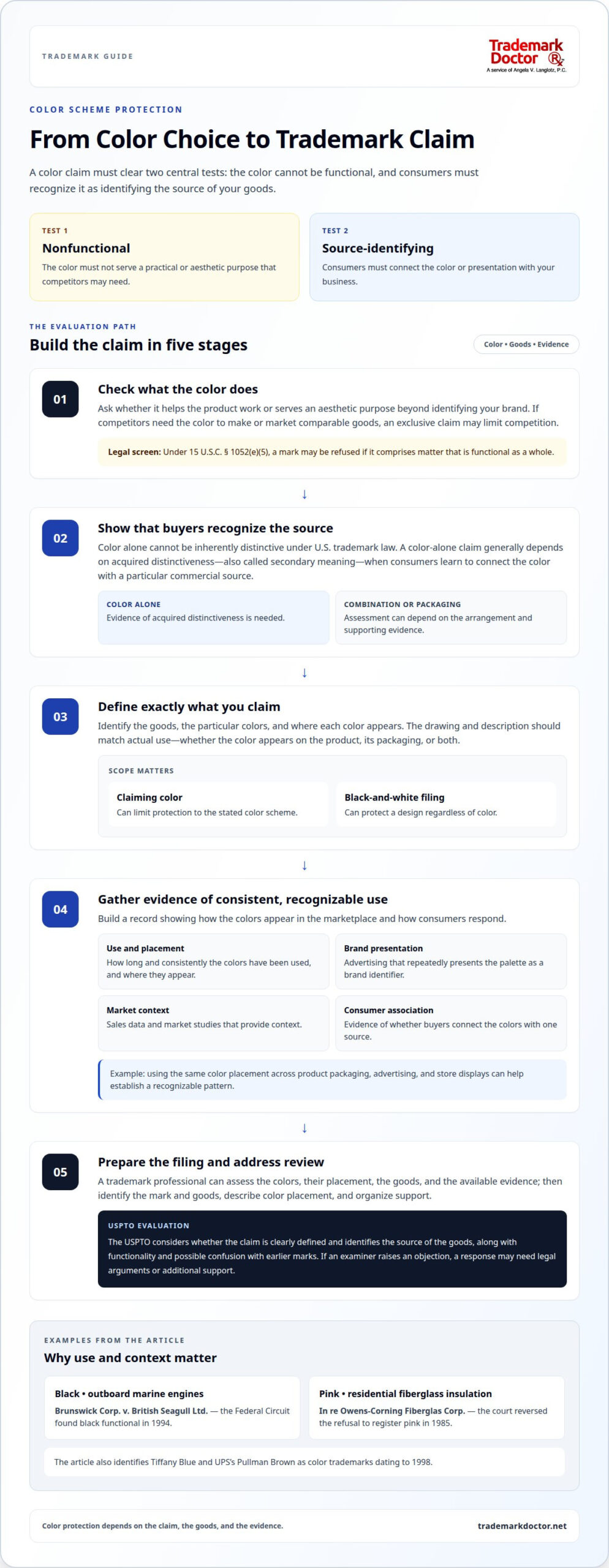
Yes, you can trademark a color scheme in the United States if it is nonfunctional and consumers recognize it as identifying your brand. Color alone cannot be inherently distinctive, so protection generally depends on evidence that consumers have learned to associate the colors with your business. The key questions are whether the colors are functional and whether they distinguish your goods. Here’s how those requirements apply to color combinations and packaging.
Key Takeaways
- Assess whether a color serves a practical product function, since that can limit trademark protection.
- Learn what kinds of evidence can help show consumers recognize your colors or packaging as a source identifier.
- Understand how claiming color in an application can affect the scope of protection for a design.
- See how a trademark professional can evaluate a proposed color mark and support its application.
Functional-use limits on color trademarks
A color can identify a brand, but trademark protection has an important limit: the color cannot be functional. This distinction matters when a color choice also helps a product work or compete.
Aesthetic Functionality and Functional Colors
Functional colors serve a practical purpose or, in some cases, an aesthetic purpose beyond identifying the brand. Exclusive rights could restrict competitors from using a color they need to make or market comparable goods. So the question is not simply whether a shade looks distinctive. Its role in the product and marketplace matters, too.
In Brunswick Corp. v. British Seagull Ltd., the Federal Circuit found black functional for outboard marine engines in 1994. By contrast, in In re Owens-Corning Fiberglas Corp., the court reversed the refusal to register pink for residential fiberglass insulation in 1985. Those examples show why evidence about a color’s purpose and use can shape a registration decision.
Risks and Objections to Color Claims
A color claim can face an objection if the color is functional, lacks distinctiveness, or conflicts with another mark. Under 15 U.S.C. § 1052(e)(5), a mark may be refused if it comprises matter that is functional as a whole. A color used for a practical product feature may therefore be difficult to claim exclusively, even if owners use it consistently.
How long does registration take, and how long does protection last? Processing time depends on the examination and whether objections require a response. Protection depends on the mark continuing to identify the source of goods and remaining legally protectable.
Risks include refusal based on functionality or insufficient evidence that buyers recognize the color as identifying a source. For example, if competitors need a color for a practical or aesthetic product purpose, an exclusive claim could limit their ability to compete. A clear record of how the color is used in the marketplace helps address these concerns.
How can a trademark professional help prove that your color scheme or packaging is distinctive?
A color scheme must be nonfunctional and identify your goods as coming from one source. It gains acquired distinctiveness when consumers learn to associate it with your brand through consistent use.
Acquired Distinctiveness and Source Identification
Acquired distinctiveness, also called secondary meaning, means consumers connect a color or design with a particular commercial source. This matters because color alone cannot be inherently distinctive under U.S. trademark law. A trademark professional can evaluate whether your actual use helps consumers recognize your brand, rather than merely decorating a product or package.
For example, a business might use the same color placement on product packaging, advertising, and store displays. Consistent use can help establish a recognizable pattern. The application also needs to identify the goods and describe how the colors appear in relation to them. A patent protects a different kind of right; trademark evidence must show that the colors identify the source.
Evidence Supporting Distinctiveness
Evidence may show how long and consistently you have used the colors, where they appear, and how consumers respond. Advertising that repeatedly presents the palette as a brand identifier may help. Sales data and market studies can provide context, while consumer association evidence may show whether buyers connect the colors with one source.
Packaging also needs careful analysis. A distinctive package design may qualify as trade dress if it is nonfunctional and identifies the source. In In re Forney Industries, Inc., the Federal Circuit rejected a broad rule that described multicolor packaging could never be inherently distinctive. A trademark professional can organize relevant evidence and explain how your particular presentation differs.
Requirements for Color Protection
To qualify, a color claim must be nonfunctional and identify the source of the goods. A claim for color alone also needs acquired distinctiveness. A color combination or packaging design may be assessed differently, depending on its arrangement and the evidence. These distinctions affect what you claim and what proof supports the application.
A professional can assess the proposed colors, their placement, the goods, and available evidence before filing. That review helps define the claim clearly and address weaknesses, such as inconsistent use or packaging that consumers see as decoration. A trademark availability evaluation can help assess the proposed mark and potential conflicts before an application moves forward.
Pepto-Bismol and Cheerios color trademark applications
Pepto-Bismol and Cheerios illustrate why a color claim must be defined precisely. The wording of the application can shape the scope of protection.
Defining and Claiming Color in Applications
A color claim describes the particular color and how it appears on identified goods. That detail matters because claiming color can limit protection to the stated scheme, while a black-and-white filing can protect a design regardless of color.
For a Pepto-Bismol or Cheerios package, the application must clearly show where each claimed color appears. The drawing and description should match the actual use. A shade used on the product itself may present a different claim from one used only on its packaging. Precision helps prevent an application from suggesting broader rights than intended.
Filing and USPTO Evaluation
A trademark professional prepares an application by identifying the mark and goods, describing color placement, and organizing supporting evidence. The USPTO evaluates whether the claim is clearly defined and whether the mark identifies the source of those goods. It also considers functionality and possible confusion with earlier marks.
The work depends on factors such as the number of colors, their placement, the goods, and the available evidence. If an examiner raises an objection, the applicant may need to respond with legal arguments or additional support. Pepto-Bismol and Cheerios should not be treated as proof of registration outcomes without examining each application’s record.
Examples of Registered Color Trademarks
Tiffany Blue and UPS’s Pullman Brown have both been trademarked since 1998. These examples show how a color may identify a particular source in a defined marketplace, rather than grant its owner control over that color in every setting.
For your application, the USPTO’s assessment turns on how the claimed color is used with specific goods and the supporting record. A color used on packaging, for instance, needs a clear description of its placement. The same analysis applies whether the claim concerns one shade or a combination.
Trademark protection for color combinations
In the United States, a company may seek protection for one color or a combination. The colors must identify a source, not merely serve a product function. Can you trademark a color scheme? Potentially, if the particular use meets those requirements.
Single Colors and Color Combinations
A single color can qualify when it identifies a source and is nonfunctional. In 1995, the Supreme Court held in Qualitex Co. v. Jacobson Products Co. that color alone can serve as a trademark.
A combination can also identify a brand through its particular arrangement. The key is consumer recognition: people must connect the colors with one source, not merely see them as decoration. Whether you can trademark a color scheme depends on the goods, the arrangement, and how consumers understand it.
Color Scheme Protection in the United States
Color schemes can receive protection in the United States, but the nature and context of their use matter. In 2020, In re Forney Industries, Inc. rejected a broad rule that described multicolor packaging could never be inherently distinctive.
That does not make every palette distinctive. The claimed colors still need to identify a source, and functional use can limit protection. The scope relates to the goods and market where consumers recognize the scheme; it does not grant control over those colors in every industry.
For example, a palette used consistently on packaging and advertising may help consumers recognize a brand. A similar palette used by another seller could raise concerns about confusion. The U.S. Government Publishing Office explains that a color mark may be refused if it is likely to cause confusion with a registered or previously used mark.
A focused trademark application can define the colors and goods clearly. Evaluate your color trademark before filing to address the claim’s scope and potential conflicts.
Trademark Doctor
Trademark Doctor can help you assess whether your colors may qualify for trademark protection and how to present the claim. If you’re weighing a particular palette, its use on your goods, packaging, and advertising can shape the application and supporting evidence. A trademark availability evaluation can assess potential conflicts, while application filing and examination support can address the next stages. If the USPTO raises an Office Action, a response can address the examiner’s concerns using the application record and relevant evidence. This is useful when you need professional help defining the proposed mark or responding during examination. Contact Trademark Doctor to discuss your color trademark question.
Make your next brand decision with care
Your color palette is part of a larger visual identity. Before developing more packaging, advertising, or product materials around it, consider how consistently you use the colors and whether their presentation could change. A clear plan can help keep future brand decisions aligned with the identity you want consumers to recognize.
Whether you can trademark a color scheme depends on the details of the mark, its use, and the evidence supporting it. Trademark Doctor offers trademark availability evaluations, application filing, and examination support, including responses to Office Actions. These services can help you understand the application process and address issues during examination, without treating registration as automatic. Website content is general information only, not individualized legal advice or a substitute for advice from an attorney.
If you’re ready to discuss how your brand colors fit into a trademark strategy, contact Trademark Doctor about your brand. A thoughtful next step can help you protect the identity you’re building.
Frequently Asked Questions
What is a color trademark?
A color trademark is a color or color arrangement used to identify the source of particular goods or services. For example, if shoppers see a specific color pattern on a product’s packaging and recognize the brand behind it, that pattern may function as a mark. The claim concerns the color’s role in identifying the source, not ownership of that color for every use.
Does my logo registration protect my brand color?
Not necessarily. A registration for a logo may protect the design shown in the application, while a separate color claim may be needed to seek rights in a particular color. Review the registered drawing and description to understand what the registration covers. For example, a logo filed in black and white may protect its design without limiting the claim to the colors used in your current branding.
Does the combination identify one source?
It can, if consumers connect the combination with one business rather than viewing it as ordinary decoration. Imagine a maker that uses the same two-color border on its boxes and product labels, while competitors use different layouts. That arrangement may help signal a common source. The colors alone are not enough; how you present them and how consumers respond matter.
Is it nonfunctional?
A color combination is nonfunctional when it does not serve a practical or competitive purpose for the goods. Consider a fictional snack brand that uses a distinctive color arrangement solely as a recurring visual identifier. That differs from choosing a color because it improves the product’s operation or provides a useful feature. The specific goods and marketplace context guide the analysis.
What does secondary meaning mean for color?
Secondary meaning means consumers have learned to associate a color with a particular business, beyond its ordinary visual effect. For instance, customers might recognize a consistent color treatment on a company’s goods before reading its name. The association must identify the source, not merely reflect the color’s appearance or appeal. That is why the context of use matters to a color claim.
What makes a color functional?
A color may be functional if it helps a product work, provides a useful feature, or gives competitors a practical need to use it. For example, a finish chosen to make a product easier to identify in a particular setting could serve a purpose beyond branding. The assessment considers the product and the color’s role, not simply whether the owner intended it to identify the brand.