

A federal database search can miss a conflict that derails a brand. A trademark conflict search needs to look beyond USPTO records because U.S. trademark rights can arise from use in commerce, even when no federal application or registration appears.
Checking for similar names before filing or launching is a sensible first step, but a clear federal search is only an early signal. State trademark records, state business registries, and evidence of real-world use can reveal other risks. An available domain does not settle the trademark question, and a business-name filing alone does not establish trademark rights.
This guide explains how a professional search weighs similarities in appearance, sound, and meaning against related goods or services. It also covers how federal and state records, along with online use, can help you understand potential conflicts before committing to a name or investing in packaging, marketing, inventory, and customer recognition.
Key Takeaways
- Look beyond federal records by considering state registrations, marketplace use, and relevant international sources.
- Assess potential conflicts by comparing how marks look, sound, and read, alongside the goods or services they identify.
- Distinguish state business-name filings from trademark rights; a registered company name alone does not settle whether a brand name conflicts.
- Use a professional evaluation to understand the significance of search results and the next steps before filing or launching.
Why Should You Search a Trademark Before Filing?
Search before filing because federal records show only part of the picture. U.S. rights can arise through use in commerce. Professionals compare marks that look or sound alike, then assess their meaning and the goods or services involved to identify risks that consumers could mistake as coming from the same source.
-
How Professionals Search Federal Trademark Records
Give the professional the proposed mark, its spelling or design, and the goods or services you plan to offer. The search covers identical names and variations that look or sound similar in the USPTO federal trademark database. It reviews registered marks and pending applications, since an earlier pending application may affect a later one if it registers. Don’t rely on an exact-name match alone; a different spelling or sound can still deserve review.
-
How Professionals Check State, Pending, and Common-Law Marks
Ask for a search that goes beyond federal records to include state trademark registrations and real-world use. Professionals consider how a mark appears in business directories, websites, and other online sources, then compare the users’ goods or services and market activity. A federal database may not reveal an unregistered common-law mark, and a record marked dead may still matter if its owner continues using the name. These details help distinguish a database result from actual marketplace activity.
-
When to Expand a Professional Search to Broader and International Records
Share where you plan to sell and whether your goods or services may reach customers outside the United States. That information helps determine whether relevant international records should be included. A broader review can combine federal applications and registrations, state records, common-law use, and online sources. The goal is to identify meaningful conflicts in markets connected to your planned launch, not simply collect names from unrelated records.
-
Account for Database Limitations
Treat a database result as evidence to investigate, not as a final clearance decision. The USPTO database contains federal applications and registrations, but not every mark used in the United States. A clear result therefore cannot rule out state or common-law rights. Professionals assess findings against how marks are used and whether the goods or services are related before evaluating risk. This distinction matters before you commit to a name or build a launch around it.
What Is Likelihood of Confusion?
Likelihood of confusion asks whether consumers could mistakenly connect two brands. Assess a proposed mark alongside the goods or services and the marketplace context.
-
Compare the Marks and Their Goods or Services
Compare the proposed mark with each relevant mark in appearance, sound, meaning, and overall impression. Then consider whether the goods or services are related, not just whether their names match. For example, similar names for related products may raise more concern than similar names for unrelated offerings. Different international classes do not automatically make goods or services unrelated. The question is whether consumers could assume the same business offers or sponsors them.
-
Apply the Likelihood-of-Confusion Analysis
Ask a professional to apply the relevant analysis before filing an application, rather than treating a name match as the whole answer. In the United States, Lanham Act § 43(a) supplies a likelihood-of-confusion test for significant conflicts, while Trademark Act Section 2(d) addresses refusal of an application over a conflicting mark. The USPTO may refuse an application when consumers could mistake the source of related goods or services. The strength of the proposed mark and its similarity to existing marks also matter.
-
Consider Actual Confusion and Marketplace Context
Give the professional concrete examples of how consumers encounter the marks in commerce. Relevant context includes the goods or services offered, how each brand presents itself, and the channels where customers see or buy the offerings. Customer inquiries or misdirected orders may help show actual confusion, but they must be considered alongside the marks and marketplace. A lack of reported mix-ups is not automatic clearance; a newer brand may have had little time to generate evidence.
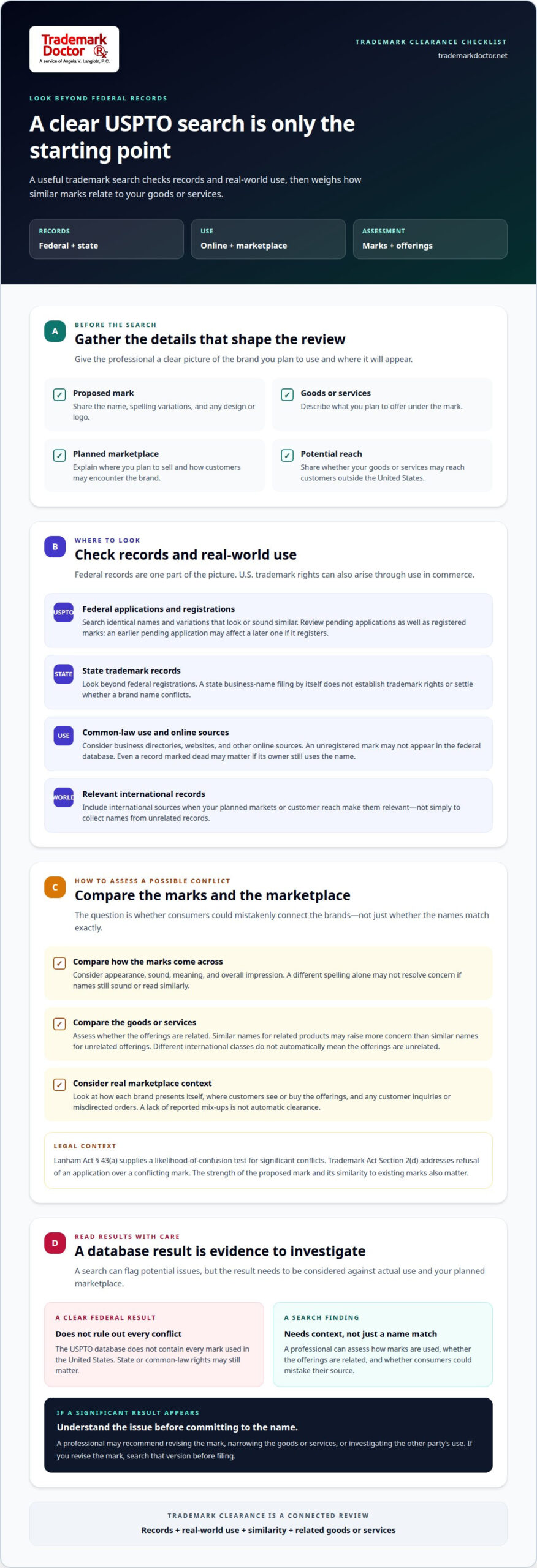
Trademark clearance searches before filing or launching
A basic search screens federal records for obvious conflicts. A broader clearance search can also cover state, common-law, online, and relevant international records. A trademark conflict search is only a starting point: professional analysis connects the records to your planned marketplace and goods or services.
- Before investing in a launch, organize the proposed mark, alternate spellings, logo, and planned goods or services. A preliminary screen can flag obvious conflicts while you still have room to revise the name or branding. An available domain or an exact-name search with no results does not prove that a mark is clear. Neither check resolves unregistered marketplace use or similar names.
-
Review Clearance Recommendations and Mitigation Strategies
Ask the attorney to explain each significant result and recommend a practical response. A conflict may call for revising the mark, narrowing the goods or services, or investigating how the other party uses its mark. Changing a spelling alone, for example, may not reduce concern if consumers could still hear or understand the names similarly. If you revise the mark, run a fresh clearance search on that version before filing.
-
Follow a Professional Clearance and Filing Process
Give the attorney accurate details about your proposed name, design, goods or services, and intended marketplace. A professional trademark clearance search can compare federal records with state registrations, common-law uses, and relevant online or international sources. The analysis weighs similarities and marketplace context, explains substantial risks, and identifies possible next steps. A report that only lists names does not explain whether those marks may cause confusion.
Use the findings to make a considered filing decision. If the mark appears suitable, an attorney can prepare the application based on the information you provide, including the goods or services it should cover. If results raise concerns, address them before launch rather than assuming an application will settle another owner’s rights. A revised mark needs its own review.
State trademark and business registry searches
- Ask a professional to search state trademark registries in states connected to your planned sales or operations. A state trademark registration is different from a business entity filing, so review both types of records. A company name listed with a state may identify a business, but it does not by itself establish trademark rights or show whether another brand uses a similar mark.
- Use state business registries as leads, not as a clearance decision. A filing can reveal a similar company name, but it does not show whether that business uses the name as a brand, what goods or services it offers, or where it operates. For example, two companies may have similar names but work in different industries. The actual marketplace context matters.
- Have the professional investigate possible common-law rights associated with relevant names. This means looking at actual use, including the goods or services connected to the mark and the markets where customers encounter it. Compare spelling, sound, appearance, and commercial impression. A state registry entry can point to a potential user, but evidence of use and marketplace activity helps explain the practical significance for your proposed trademark application.
- Use the combined results to distinguish entity-name issues from trademark risk. A state business filing does not automatically create trademark rights, and registering a company name does not prevent another business in that state from using a similar name in a different industry. The analysis should identify what each record establishes, whether actual use suggests common-law rights, and what steps make sense before launch or filing.
For a professional review of state records and potential trademark conflicts, request a trademark availability evaluation.
Trademark Doctor
Trademark Doctor helps you assess a proposed brand and choose a practical next step before filing or launching. If search results raise questions about similar names, related goods or services, or possible common-law use, a trademark availability evaluation can help you understand the findings and assess your options. When you’re ready, Trademark Doctor also handles trademark application filing and examination issues, including Office Action responses. Its Online Intellectual Property Issues services can help when brand concerns extend beyond the application process.
A search informs your decision; it does not guarantee registration or prevent every dispute. If you need help interpreting potential conflicts or deciding what to do next, contact Trademark Doctor.
Make Your Next Brand Decision Deliberately
Your brand name will shape more than a trademark application. It can become part of product plans, retailer relationships, marketing campaigns, and customer recognition. Treat a trademark conflict search as an early business decision, not a box to check after investing in a launch. If uncertainty remains, pause before committing more resources and assess how the available paths fit your plans.
Trademark Doctor can evaluate availability, prepare and file an application, and respond to examination issues or Office Actions. Trademark attorney Angela Langlotz has filed hundreds of trademark registrations, bringing practical experience to decisions about protecting a brand. Registration is not automatic, so choosing a careful next step matters.
Ready to discuss your brand’s next move? Contact Trademark Doctor and take a considered step toward protecting the value you’re building.
Frequently Asked Questions
Can I trademark a name if no one has registered it with the USPTO?
Yes. You may apply even if no federal registration exists, but the name still must qualify for registration. If you have not launched, you may file a federal application based on a bona fide intent to use the mark in commerce. This route lets you address the brand before launch, but you must follow the application requirements for that filing basis.
Do competing trademarks have to be in the same trademark class?
No. A class is an administrative category, not a shortcut for deciding whether two names can coexist. Describe the specific goods or services you plan to sell instead of choosing a class based only on your industry label. An application may cover goods or services in more than one class, so the description and classification should match your actual plans.
Do trademarks have to be identical to conflict?
No. A mark can raise concerns without matching another mark letter for letter. For example, “Kwick” and “Quick” differ in spelling but may sound alike when spoken aloud. Search variations customers might hear, type, or remember, including alternate spellings and spacing. A different logo or a small spelling change is not an automatic fix.
Does a Similar Trademark Name Always Mean I Have to Rebrand?
No. In some circumstances, two businesses may agree to coexist under defined boundaries, if both parties agree. Those boundaries might address how each business uses its mark or the markets where it operates. Do not assume an agreement is available or appropriate in every dispute; assess the parties’ rights and practical interests before relying on one.
How Can a Professional Check Whether a Trademark Name Is Available?
A professional can assess whether a proposed mark appears eligible for registration and whether an application is likely to be approved. Provide the intended mark and a clear description of your goods or services so the assessment reflects your actual plans. The resulting opinion can explain key risks and expected registration timing, helping you decide whether to proceed, revise the mark, or pause.
Should I Contact the Other Brand Owner Myself?
Consider getting legal advice before contacting the other owner, especially if you have received a demand or expect a dispute. Keep any notice, message, or product example, and avoid making statements or commitments before you understand the issue. If contact makes sense, a carefully planned response can keep the discussion focused on the specific marks and business uses involved.