

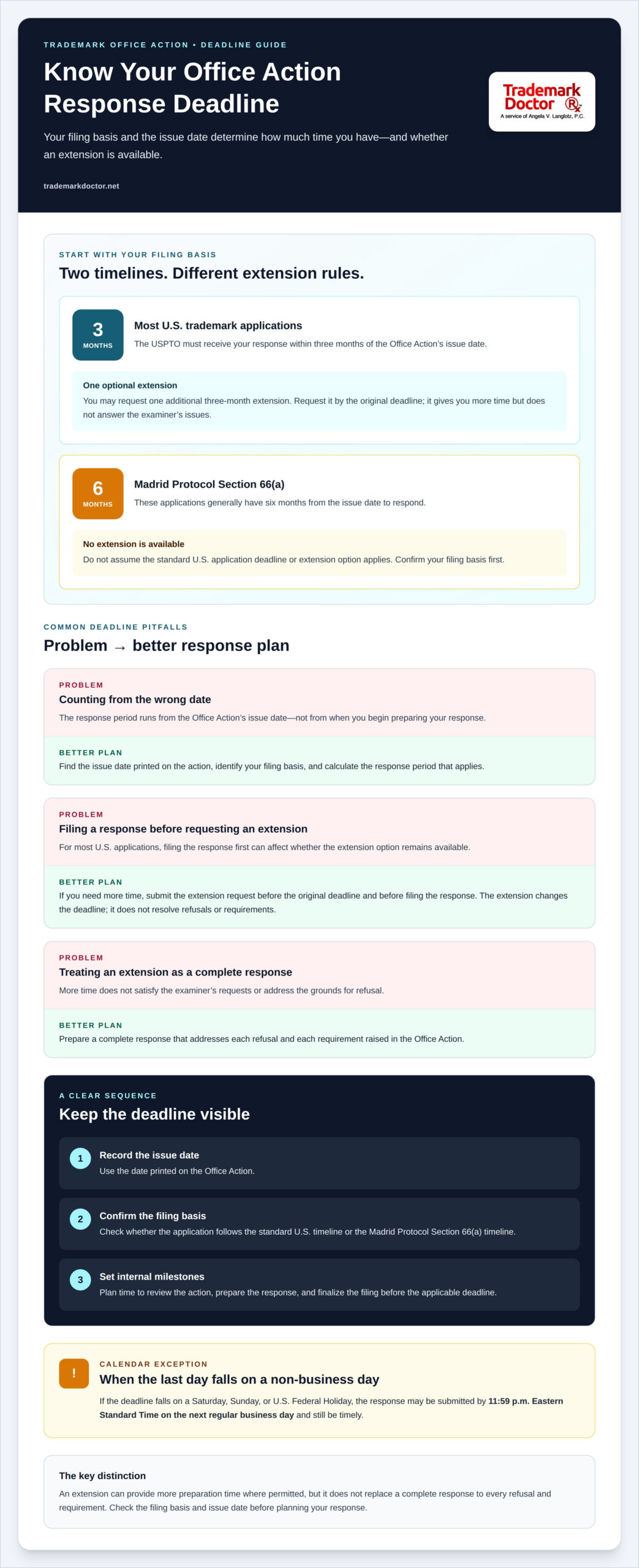
For most U.S. trademark applications, the USPTO must receive your response within three months of the Office Action’s issue date. The United States Patent and Trademark Office allows one optional three-month extension for a government fee, but you must request it by the original deadline.
If your application was filed under Madrid Protocol Section 66(a), you generally have six months to respond and can’t extend that period, so identify your filing basis and the issue date before deciding how to respond to a trademark Office Action. An extension gives you more time to prepare, but it doesn’t replace a complete response to each refusal or requirement.
An Office Action identifies a legal or procedural issue with your application, but it doesn’t automatically end the process. This guide explains what a nonfinal action means, how to manage the deadline, and how a focused response may address a likelihood-of-confusion refusal by analyzing the marks, related goods or services, and relevant audiences.
Key Takeaways
- Learn how nonfinal and final Office Actions differ, and why the distinction affects your next move.
- See what to track when planning a response deadline or considering an extension.
- Understand how differences between marks, goods, services, and audiences can matter in a likelihood-of-confusion refusal.
- Find out how an attorney can address each refusal or requirement with a focused response.
What is an office action?
A trademark Office Action is a letter from a USPTO examining attorney identifying issues with a trademark application. The examiner reviews whether the mark qualifies for registration and may raise legal refusals, application requirements, or both. A nonfinal Office Action is the first round, giving you an opportunity to address each issue. It does not, by itself, end the application.
For example, a nonfinal letter might require clarification of the goods or services while also refusing registration on another ground. Each point needs a direct response. If the response doesn’t resolve the examiner’s concerns, the USPTO may issue a final Office Action. “Final” marks a procedural change, not an automatic loss: the remaining issue and available options depend on the application.
After a final Office Action, an applicant may be able to submit an acceptable amendment, request reconsideration, appeal to the Trademark Trial and Appeal Board (TTAB), or consider a different brand strategy. A request for reconsideration asks the examining attorney to review the refusal again, often based on arguments, evidence, or a proposed amendment. Under 37 C.F.R. §2.64(b), reconsideration does not extend the appeal deadline. File a separate Notice of Appeal when needed to preserve the right to appeal.
When handling a final Office Action, an attorney reviews the application record, the examiner’s reasoning, and the response history. This helps determine whether the record supports reconsideration, an appeal, a permitted amendment, or another path. If reconsideration is appropriate, the attorney presents focused arguments or evidence addressing the outstanding refusal. If an appeal is appropriate, the attorney prepares the Notice of Appeal and develops legal arguments for TTAB review. If both are pursued, the appeal is processed first, after which the application can return to the examining attorney to review reconsideration.
There isn’t one fix for every final refusal. A final response must address the examiner’s specific grounds and the application’s procedural posture. An attorney can explain which options fit the record and what each step asks the USPTO or TTAB to decide.
Response deadlines and extensions
For most U.S. trademark applications, the USPTO must receive your response within three months of the Office Action’s issue date. The United States Patent and Trademark Office sets this deadline, so use the date printed on the action to plan the filing. The response must address the examiner’s requirements and refusals. Starting early gives the attorney handling your application time to review the record, prepare supporting arguments, and submit a complete response.
If you cannot prepare the response by the initial deadline, an extension may provide more time. The extension request must come first. Filing a response before requesting the extension can affect whether that option remains available. An extension changes the response deadline; it does not resolve any issue raised by the examiner.
Madrid Protocol Section 66(a) applications follow a different schedule. According to the United States Patent and Trademark Office, these applicants generally have six months from the Office Action’s issue date to respond, and extensions are not permitted. That means an extension request is not a fallback for a Madrid-based application. The filing basis matters, so confirm it when planning the response rather than assuming the standard application deadline applies.
To keep the deadline visible, record the issue date, calculate the applicable response period, and set internal milestones for reviewing the action and finalizing the filing. If the last day falls on a Saturday, Sunday, or U.S. Federal Holiday, the response may be submitted by 11:59 p.m. Eastern Standard Time on the next regular business day and still be timely. For help preparing a response around the applicable deadline, an attorney can manage the filing and address each outstanding point. A focused trademark Office Action response can keep the application moving through examination.
Likelihood-of-confusion refusals
An Office Action can raise a refusal, a procedural requirement, or both. A refusal challenges registration; a requirement asks for a change or clarification. For example, an examiner may request a clearer goods description while also citing another mark. Each issue needs its own response. An amendment may clarify or limit the goods or services, but it cannot expand their scope beyond the application’s limits.
A Section 2(d) refusal means the examiner found a similar registered mark used with related goods or services, creating a likelihood that consumers could confuse their source. The analysis considers the marks’ appearance, sound, meaning, and overall commercial impression, alongside the goods, services, and likely audiences. The USPTO evaluates these issues using factors from the 1973 In re E. I. du Pont de Nemours & Co. case. A useful response addresses the examiner’s specific comparison, not just your belief that the names look different. For example, differences in sound may matter less if both marks suggest a similar meaning and identify related products.
A descriptiveness refusal raises a different issue. Under Section 2(e)(1), a mark may be refused when its wording or design merely describes an aspect of the goods or services. A commonly used phrase can face this concern if buyers would read it as ordinary descriptive wording rather than as a brand. The response may explain why the mark suggests an idea instead of directly describing the offering. Depending on the application, possible responses may include evidence of distinctiveness, an appropriate amendment, or a disclaimer addressing particular wording.
A specimen refusal concerns the example submitted to show actual trademark use. For instance, a product label may show the mark, while a general advertisement may not clearly connect it to the listed goods. The response should address the examiner’s stated concern and provide a suitable example or explanation when supported by the record. Confusion, descriptiveness, and specimen issues require different evidence and arguments; treating them as one problem can leave a refusal unanswered.
How a trademark attorney responds to a nonfinal examining attorney Office Action
Hire a U.S. trademark attorney promptly after receiving a nonfinal Office Action, especially if it includes a legal refusal, several requirements, or a likelihood-of-confusion issue. If you need to respond to a trademark Office Action, early review gives the attorney time to assess the application record and prepare a complete response before the deadline.
The attorney first reviews the examiner’s letter and separates each refusal from each procedural requirement. Then the attorney examines the application, cited registrations, goods or services, and evidence already in the record. This helps identify which points need legal arguments, clarification, or a response explaining whether you agree or disagree. Every issue matters: overlooking one requirement can leave it unresolved.
Next, the attorney develops arguments and amendments that address the examiner’s concerns. If the examiner questions the goods or services description, the attorney may propose wording that clarifies or limits it. If the refusal concerns descriptiveness, the attorney can assess whether the mark suggests the offering rather than directly describing it. For a specimen issue, the attorney reviews the submitted example and considers whether the record supports an explanation or substitute specimen.
Evidence and wording must support the application. The attorney may organize use records, advertising materials, or other relevant evidence that addresses the examiner’s concern. The response should avoid unsupported claims and changes that alter the mark’s identity. Before filing, the attorney checks that every point has a corresponding answer, any amendment fits the application, and the response is properly signed and submitted through the Trademark Electronic Application System.
A response must reach the USPTO server before 11:59 p.m. Eastern Standard Time on the final day. If the examiner maintains an issue, a later Office Action may identify what remains, and a final refusal can make an appeal relevant. The practical takeaway is to involve counsel while the action is nonfinal. An attorney can help you respond to a trademark Office Action with arguments and evidence tailored to the record. Get help responding to a nonfinal Office Action through a focused review of the application and examiner’s concerns.
Trademark Doctor: Trademark examination and Office Action responses
Trademark Doctor handles trademark examination and Office Action responses when an examiner raises a refusal or application requirement. Contact the firm after receiving an Office Action, especially if it raises several issues or challenges whether your mark qualifies for registration.
The response focuses on the examiner’s stated concerns and the application record. This means distinguishing legal refusals from procedural requirements, assessing what evidence or amendment may address each point, and preparing a response that answers the action without overlooking an issue. The appropriate approach depends on the specific refusal and the record.
If you’re still preparing to file, Trademark Doctor also offers trademark availability evaluation and application filing. If you’ve received an Office Action, contact Trademark Doctor to discuss a response.
Keep your brand strategy moving forward
An Office Action is also a decision point for your brand strategy. Consider whether the mark still fits the products, services, and audience you plan to serve. This broader view can help you weigh your response against the brand you’re building, rather than treating the examiner’s letter as paperwork alone.
Trademark Doctor offers trademark availability evaluation, application filing, and examination and Office Action responses. These services can support you at different stages, from evaluating a proposed mark to addressing an examiner’s concerns. The right next step depends on the issues in your application and what you want the mark to do for your business.
When you need to respond to a trademark Office Action, a focused review of the application record can help you decide how to proceed. Contact Trademark Doctor to discuss your next step and move forward with a clear plan.
Frequently Asked Questions
Can you guarantee approval?
No. Trademark Doctor cannot guarantee USPTO approval because the USPTO decides whether an application qualifies for registration. Arguments or amendments do not control that decision. Website content is general information only, provided “AS IS” without warranties of merchantability, fitness for a particular purpose, or non-infringement. Retain an attorney for personalized advice about your application; reading website material alone does not create an attorney-client relationship.
Can you help if I filed the application myself?
Yes. Trademark Doctor offers examination and Office Action responses for applicants who prepared and filed their own applications. An attorney can assess the application record, the examiner’s objections, and supporting documents such as a specimen or evidence of use. Legal services or representation require a signed Legal Services Agreement and payment; reading general website information does not establish that relationship.
Does a refusal mean my application is over?
No. A refusal identifies a concern about registration, but it doesn’t always end the application. For example, an examiner might accept an amendment that addresses a wording issue while maintaining a separate refusal. If the USPTO issues a final refusal, procedural options, including an appeal, may be available depending on the record and applicable deadlines.
How quickly do I need to respond?
For most U.S. trademark applications, the USPTO must receive a response within three months of the Office Action’s issue date. A Madrid Protocol Section 66(a) application generally has six months, with no extension option. For example, an applicant with a Madrid-based filing shouldn’t assume the extension available for most other applications applies to theirs.
What happens if you miss the deadline?
If you miss the response deadline, the USPTO may abandon your application. If the delay was unintentional, you may submit a Petition to Revive. Generally, it must be filed within two months of the notice of abandonment. If you didn’t receive that notice, the period is generally two months from when you learn of the abandonment, but no later than six months after its date in TSDR.
How do I identify the response deadline for a trademark Office Action?
Start with the Office Action’s issue date and the filing basis shown in your application record. According to the United States Patent and Trademark Office, most applications have a three-month response period, while Madrid Protocol Section 66(a) applications generally have six months. Also check whether the notice is an Office Action or another type of correspondence, since different notices can carry different deadlines.