

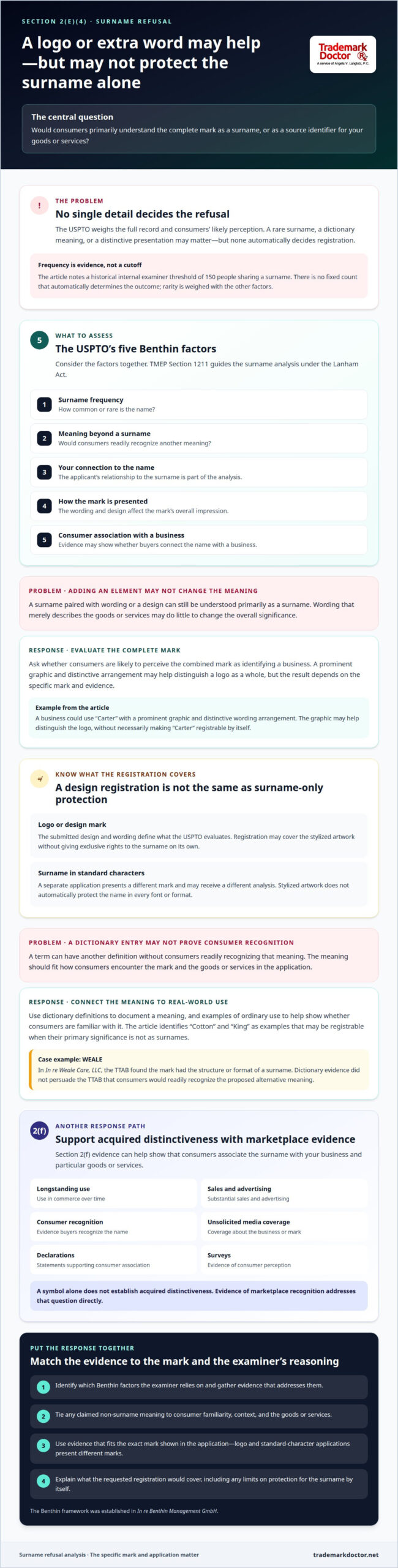
A surname trademark refusal under Section 2(e)(4) isn’t automatically defeated by adding another word or a design; the combination may help if the full mark creates a distinct commercial impression, but the USPTO still considers whether consumers primarily understand the mark as a surname. A distinctive logo may support registration of the design without giving you exclusive rights to the surname by itself.
If you’ve received this refusal, you may think adding another element should make your mark distinctive. The key question is how consumers perceive the mark as a whole, considering factors such as how common the surname is, whether it has a recognized meaning beyond a last name, and whether consumers associate it with your business.
This article explains the USPTO’s five-factor analysis and ways to respond, including evidence of a recognized non-surname meaning or acquired distinctiveness. It also explains when added wording or a design may help, what those options may leave unprotected, and why the specific mark and application matter.
Key Takeaways
- Understand the five factors the USPTO weighs when deciding whether consumers primarily perceive a mark as a surname.
- See why adding wording or a design can change the mark’s overall impression, but may not protect the surname by itself.
- Learn what evidence can support an argument that a name has another meaning or has become distinctive through consumer recognition.
- Explore how an Office Action response can address the examiner’s reasoning and present evidence relevant to your application.
Q3: How does the USPTO determine if a name is “primarily merely a surname”?
A surname trademark refusal under Section 2(e)(4) turns on whether consumers would primarily understand your mark as a last name, not as a source identifier. The USPTO weighs five Benthin factors, including surname frequency, other meanings, and how the mark appears.
Surname Evaluation Factors
The five Benthin factors assess the mark’s primary significance to buyers. They include surname frequency, recognized meaning beyond a surname, your connection to the name, the mark’s presentation, and consumer association with a business. For a surname trademark refusal under Section 2(e)(4), the combined evidence matters; no single factor automatically decides registration. TMEP Section 1211 guides the analysis under the Lanham Act.
Surname Frequency and Rarity
Surname frequency helps assess whether consumers are likely to recognize a term as a last name. When John Miranda was at the USPTO, 150 people sharing a surname was an internal examiner threshold that generally supported issuing a refusal. How common or rare must a surname be to avoid one? There is no fixed count that automatically decides registration. Evidence of rarity can help, but the USPTO weighs it with the other factors. A surname trademark refusal under Section 2(e)(4) therefore depends on the full record, not just a name count.
Evidence in Surname Refusals
Evidence should address the Benthin factors and consumer perception. The USPTO may consider references to the name as a surname, dictionary evidence of other meanings, your connection to the name, how the mark is presented, and whether consumers associate it with a business. A dictionary entry alone may not show that consumers recognize another meaning. In Weale, the TTAB found that consumers would not readily recognize the proposed alternative meaning of WEALE. Tailor the evidence to the examiner’s reasoning.
Examples of USPTO Surname Decisions
Decisions show how the USPTO and TTAB apply the factors to specific records. In In re Benthin Management GmbH, 37 USPQ2d 1332, 1333-1334 (TTAB 1995), the TTAB established the five-factor framework. In In re Weale Care, LLC, decided Sept. 26, 2023, the TTAB found WEALE had the structure or format of a surname. Dictionary evidence did not persuade the TTAB that consumers would readily recognize another meaning, underscoring the importance of evidence tied to consumer perception.
Adding distinctive elements to a surname mark
Distinctive wording or a design can affect how consumers perceive a mark, but it does not automatically overcome a surname refusal. The USPTO evaluates the complete mark, including its wording and presentation. A surname in a distinctive logo may qualify for registration as a design mark even if the plain surname remains difficult to register. That registration may not give you exclusive rights to the surname on its own.
For example, a business might use the surname “Carter” with a prominent graphic and a distinctive arrangement of words. The graphic may help distinguish the logo as a whole. But wording that merely describes the goods or services may do little to change the mark’s overall significance. The central question is whether consumers are likely to perceive the complete mark as identifying a business, rather than primarily as a surname.
Match your evidence to the mark shown in the trademark application. If you seek protection for a logo, the submitted design and wording define what the USPTO evaluates. A separate application for the surname in standard characters presents a different mark and may receive a different analysis. Registration of stylized artwork does not automatically protect the name in every font or format.
Another route may be acquired distinctiveness under Section 2(f). Evidence can include longstanding use in commerce, substantial sales and advertising, consumer recognition, unsolicited media coverage, declarations, or surveys. These materials can help show that consumers associate the surname with your business and particular goods or services. Simply adding a symbol doesn’t establish that connection; evidence of marketplace recognition addresses it directly.
The choice between a logo and a word mark affects the protection you seek. An attorney can assess the mark, its use, and supporting evidence before preparing an Office Action response. If the refusal targets a combined design, a focused trademark Office Action response can address how consumers perceive the complete mark and what the registration would cover.
Arguing a term has non-surname significance
The USPTO considers whether consumers in the United States would recognize a meaning beyond the surname. It looks at the term’s ordinary meaning and whether relevant consumers would readily perceive it. A dictionary entry can support your argument, but its presence alone may not show that consumers recognize the alternative meaning.
Context matters. The legislative history of the Lanham Act identifies “Cotton” and “King” as names that may be registrable when their primary significance is not as surnames. Connect the proposed meaning to how consumers encounter the mark, rather than simply listing possible definitions. The goods or services in the application may affect how consumers interpret the term.
For an Office Action, choose evidence that supports the specific meaning you claim. Dictionary definitions can document a meaning, while examples of ordinary use may help show whether it is familiar to consumers. Address the examiner’s reasoning and the goods or services in the application. A definition that exists but is obscure may carry less weight than a meaning consumers readily recognize.
In In re Weale Care, LLC, dictionary evidence did not persuade the TTAB that consumers would readily recognize the proposed alternative meaning of WEALE. The decision illustrates why an argument must address consumer perception, not merely a term’s possible definition. Explain what your evidence shows about the mark’s significance to buyers.
If the examiner maintains that the mark is primarily merely a surname, another route may be the Supplemental Register. An eligible application under Section 1 or Section 44 may seek that registration. It does not provide the same presumptions of ownership or exclusive rights as the Principal Register, so weigh the narrower protection against continued efforts to establish a distinct meaning or acquired distinctiveness.
Lanham Act surname refusal under Section 2(e)(4)
In the United States, the Lanham Act places surname refusals under Section 2(e)(4). The provision asks whether a mark’s primary significance to consumers is merely a surname. The law balances brand protection with the interests of people who share a name and may need it in business. A surname is not automatically an exclusive identifier just because one applicant uses it as a brand.
The provision was redesignated from Section 2(e)(3) to Section 2(e)(4) when the NAFTA Implementation Act took effect on January 1, 1994. That statutory history explains the section number, but the applicant’s evidence and mark remain central to the examination. To overcome a refusal, a response must address the examiner’s rationale and explain why the record supports registration. Evidence may support a recognized meaning, rarity, or acquired distinctiveness. A patent protects a different kind of intellectual property and does not resolve this trademark question.
Registration options affect the protection you receive. Evidence of acquired distinctiveness may support a Section 2(f) claim for the Principal Register; a mark used in commerce for five or more years may qualify. An eligible application under Section 1 or Section 44 may instead proceed on the Supplemental Register. That register permits some registration benefits, but does not provide a presumption of ownership or exclusive rights, which can make enforcement difficult. The right route depends on the record and the protection you seek.
How can a trademark professional respond, and what information and deadlines matter? A professional reviews the Office Action, the application, the examiner’s evidence, and information about the mark’s use and consumer recognition, then prepares a response matched to the specific refusal. According to the United States Patent and Trademark Office, the usual response deadline is three months from the Office Action’s issue date. Provide accurate records of use and marketplace recognition promptly so they can inform the response. Get help with a trademark Office Action response before the deadline.
Trademark Doctor
Trademark Doctor can help you assess a surname mark, prepare a trademark application, or respond to a Section 2(e)(4) Office Action. Turn to the team when an examiner questions whether consumers would primarily perceive your mark as a surname, or when you need to weigh evidence, mark presentation, and available registration options.
Start with the record: the wording and design in your application, the examiner’s reasons, and evidence about the name’s significance or consumer recognition. Reviewing these points together helps focus a response on the mark you seek to protect and the evidence that supports your position.
If you’re ready to discuss your surname refusal, contact Trademark Doctor.
Protect the Name Behind Your Brand
Your next move should protect the name customers recognize, not just answer the immediate refusal. A surname trademark refusal under Section 2(e)(4) calls for a strategy that fits your evidence, your application, and the rights you want to build. The choice can shape how you present the mark and what protection registration may offer.
Trademark Doctor helps business owners assess trademark availability, file applications, and address examination issues, including Office Actions. A focused review can help you evaluate the record and consider how to respond to the examiner’s concerns while keeping your broader brand goals in view.
Bring your application and the refusal into focus with a team that understands the registration process. Contact Trademark Doctor for help with your next step. A clear plan can help you move forward with greater confidence in the name you’re building.
Frequently Asked Questions
Is it possible to overcome a Section 2(e)(4) refusal by combining the surname with other elements?
Yes. Added wording or design may help if consumers perceive the complete mark as more than a surname. A distinctive logo, for example, may support registration of the design while leaving the surname itself unprotected. Consider whether you want protection for a specific logo, the wording alone, or both. The mark format in the application affects the scope of any registration.
Q1: What is the primary difference between a Section 2(c) and a Section 2(e)(4) refusal?
Section 2(c) concerns a mark that identifies a specific living person and requires that person’s written consent. Section 2(e)(4), by contrast, addresses whether consumers would primarily understand the mark as a surname. A name can raise different issues depending on whether it points to an identifiable living individual, functions as a surname, or both. The examiner’s stated basis determines the issue to address.
Q2: Can a surname ever be registered as a trademark?
Yes. A surname may register if it has acquired distinctiveness, meaning consumers recognize it as identifying a particular source. Evidence of use in commerce for five or more years may support a Section 2(f) claim, though the evidence must fit the mark and goods or services. A distinctive logo may also register as a design mark, but that does not necessarily protect the surname alone.
Q4: What kind of evidence is needed to prove acquired distinctiveness for a surname?
Evidence should show that consumers associate the surname with your business and the particular goods or services. Relevant materials may include longstanding use, sales and advertising figures, consumer surveys, unsolicited media coverage, declarations, and evidence of consumer recognition. Sales figures, for example, are more useful when tied to the mark and the goods named in the application. Together, the evidence should show how the mark is recognized in the marketplace.
Q5: What if my business name is a surname, but I don’t want to change it?
You can continue using your business name while considering how to seek trademark protection. Depending on the evidence, possible approaches include claiming acquired distinctiveness, applying to register a distinctive logo, or considering the Supplemental Register. Each route protects different interests. A logo registration, for instance, may cover the design without granting exclusive rights to the surname in plain wording.
Q6: Can I register a surname on the Supplemental Register if it’s refused on the Principal Register?
In an application under Section 1 or Section 44, a surname mark may be eligible for the Supplemental Register. This can provide certain registration benefits, but it does not create a presumption of ownership or exclusive rights. That distinction can make enforcement harder. Consider whether the narrower protection serves your business goals while you continue building consumer recognition for the mark.